

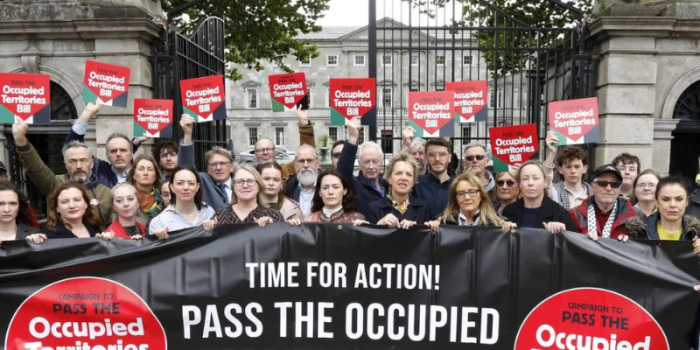
Photo: Oxfam Ireland
On 7 July 2026, the Irish Parliament officially passed the ‘Israeli Settlements in the Occupied Palestinian Territory (Prohibition of Importation of Goods) Bill 2026.’ The Bill bans the import of goods into Ireland originating from Israeli settlements in the Occupied Palestinian Territory (OPT).
Ireland is the first EU country to approve a legislative ban on goods from illegal Israeli settlements, an action which has transpired due to the determined, principled, and continued advocacy undertaken by individuals, solidarity organisations, and politicians across Ireland.
Al-Haq acknowledges and appreciates the efforts made by so many people, including Independent Senator Frances Black, Connor O'Neil, Gerry Liston, Sadaka, GLAN, and Trócaire, and welcomes the Bill. We note however, that the Bill’s failure to prohibit also trade in services has the effect of undermining the practical effects of the legislation.
While acknowledging and congratulating all of those who have advocated and supported the passage of the present Bill, and welcoming this as an initial and belated step towards justice, Al-Haq reiterates the urgency of the present situation, where genocide and apartheid have been normalised and are being facilitated and fuelled by the complicity of third states. Urgent commencement of the present Bill must be accompanied by sustained action to ensure all EU Member States, as well as the EU itself, bring their actions into compliance with their legal obligations.
BACKGROUND
The Bill's passage followed nearly a decade of political debate and legislative scrutiny. In January 2018, Independent Senator Frances Black drafted the original version of the legislation, the ‘Control of Economic Activity (Occupied Territories) Bill 2018’, which sought a strict ban on both Israeli settlement goods and services. That bill was passed through the Irish Seanad (upper house) in December 2018, and moved to the Dáil (lower house) where it passed the Second Stage in January 2019. The Bill then needed to pass two more stages of voting before being signed into law.
In 2020 progress on the Bill stalled significantly as the newly formed Government coalition questioned its compatibility with European Union (EU) trade law, suggesting that since trade is an exclusive competence of the EU, individual Member States could not impose trade bans unilaterally. Article 36 of the Treaty on the Functioning of the European Union (TFEU) provides that individual Member States can introduce restrictions on trade when they are justified as a matter of “public policy”, and as such, legal experts maintained that EU law posed no obstacle to restricting trade with illegal settlements. During this period, Al-Haq wrote to members of Irish political parties urging the Government to support the Bill and emphasising its compatibility with both Irish constitutional and EU law. Al-Haq argued that the Bill would simply give effect to Ireland's existing obligations under international law and demonstrate a commitment to accountability for human rights violations and international crimes committed in the OPT.
Following the July 2024 International Court of Justice (ICJ) Advisory Opinion, which clarified that all States are under an obligation not to render aid or assistance in maintaining Israel's unlawful presence in the OPT, the Irish Government reconsidered its approach to the Bill. In July 2025, the Irish Committee on Foreign Affairs and Trade published a pre-legislative scrutiny report, formally recommending that the final Bill encompass both goods and services so as to comply with the ICJ ruling. In late 2025, the Irish Government agreed to advance the legislation but substantially revised the bill. Although it acknowledged the Committee’s recommendations, the Government argued that including services could expose the legislation to potential legal challenges.
In May 2026 the Irish Cabinet approved the text of a modified piece of legislation, the ‘Israeli Settlements in the Occupied Palestinian Territory (Prohibition of Importation of Goods) Bill 2026’, which excluded the prohibition of services. The new Bill was formally initiated and passed First and Second Stages in the Dáil in May. In June, an amendment put forward by opposition parties to re-introduce the services ban was formally defeated at the Committee Stage. On 7 July, the Dáil passed the Bill through its Report and Final Stages without a vote, and despite opposition parties calling for services to be included.
Final debates in the Seanad were held on 15 July, and last minute efforts to seek amendments to ensure the Bill covers both goods and services were defeated.
Welcome Step
The Bill represents a historic shift in how EU Member States interact with international law, by ensuring that EU trade law regulations are not permitted to take priority over binding international law obligations.
As noted, international trade is an exclusive EU competence, meaning individual EU Member States are restricted in their capacity to enact unilateral trade bans or embargoes. EU Member States however are bound by international law, as is the EU itself as an international organisation, and cannot rely on internal agreements so as to violate international legal obligations. The Bill explicitly evokes the 2024 ICJ Advisory Opinion’s ruling that Third States, including the EU and its Member States, as well as the international community as a whole, are obliged “not to render aid or assistance” that could contribute to the maintenance of Israel’s unlawful presence in the OPT (AO, para 285(7)). By invoking the July 2024 ICJ Advisory Opinion, Ireland has demonstrated that the universal, overriding duty not to support an illegal occupation, which is an erga omnes obligation, fundamentally supersedes internal EU single-market trade rules.
By taking this unilateral step, while the EU itself has failed to abide by its own rules and cancel the EU-Israel Association Agreement given Israel’s massive and ongoing violation of human rights, Ireland has highlighted the importance of upholding international law. When introducing the Bill, Ireland’s Minister for Foreign Affairs emphasised that Ireland is coordinating with like-minded EU states to advocate for further action at the EU level.
The bill in practice
In practice, the Bill works by updating and enforcing stricter customs protocols. Sections 1 and 2 of the Bill are standard provisions setting out the relevant definitions and how the related regulations and orders will be dealt with. Sections 3 and 4 empower the Minister for Foreign Affairs and Trade, following consultation with the Minister for Finance, to proscribe by order certain postal codes that correspond to Israeli settlements and make amendments when necessary. Section 5 prohibits the importation of goods originating in postal codes proscribed by order of the Minister for Foreign Affairs and Trade.
Any such importation will therefore become an offence under Section 14 of the Customs Act 2015. Goods originating in Israeli settlements would become goods subject to any prohibition or restriction on importation within the meaning of that phrase for the purposes of the 2015 Customs Act. Once the Bill is enacted and commenced, it will be an offence under Section 14 of the Customs Act to import settlement goods and the provisions of that Act concerning search, seizure and forfeiture will be available in respect of settlement goods. Sections 6 and 7 of the Bill deal with possible exemptions and appeals for instances which require additional checks, whilst the remaining sections 8-12 set out standard provisions such as title and commencement of the Act.
Shortcomings
The effectiveness of the Bill is significantly undermined by restricting its scope strictly to physical goods and by excluding trade in services. The Irish Government has claimed this restriction is justified by relying on advice from Ireland’s Attorney General that a ban on services would pose significant legal and practical complications. The Government argues that there is no ‘public policy’ exemption in EU law for services equivalent to that governing imports. In justifying this decision, Ireland’s Minister for Foreign Affairs stated that “[t]rade in services differs fundamentally from trade in goods [...] services are often digital, cross-border and intangible in nature, operating across multiple legal and regulatory frameworks, creating very significant implementation and enforcement challenges.”
Opposition parties strongly criticized the restriction, describing the Government’s position as “unbelievably disappointing and demoralising for people who believe in politics and supporting the rule of international law.” While acknowledging there may be practical challenges in enforcing restrictions relating to services in the short term, these challenges should not prevent Ireland fulfilling its legal obligations to the full. Legal experts, including the Irish Human Rights and Equality Commission, have made clear there is no legal basis requiring the exclusion of services.
Al-Haq shares the view that the ICJ Advisory Opinion makes absolutely no legal distinction between trade in physical goods and intangible services. The ICJ affirmed that States must act upon their legal obligations to ensure that Israel’s unlawful occupation is brought to an immediate end. Specifically, the Court found that all States, including the EU and its Member States, are under an obligation:
‘not to recognize as legal the situation arising from the unlawful presence of Israel in the Occupied Palestinian Territory… not to render aid or assistance in maintaining the situation created by Israel’s illegal presence in the Occupied Palestinian Territory…, to ensure that any impediment resulting from the illegal presence of Israel in the Occupied Palestinian Territory to the exercise of the Palestinian people of its right to self-determination is brought to an end (…) and all the States parties to the Fourth Geneva Convention have the obligation (…) to ensure compliance by Israel with international humanitarian law as embodied in that Convention.’ (AO, para 279)
As previously stressed by Al-Haq, this ruling imposes an obligation on the EU and its Member States, at the very least, to ban all trade with illegal settlements in the OPT and to suspend all trade agreements that directly or indirectly contribute to the maintenance of the unlawful Israeli occupation. As this Bill fails to do so, Ireland essentially falls short of meeting its obligations under international law.
As services make up 70% of Ireland’s trade with Israel and the OPT, the practical impact of Bill in its current form will be minimised. It is reported that limiting the Bill to goods only will impact just a handful of products, including food and timber imported from Israeli-occupied territories which were worth less than one million euros between 2020 and 2024. The exclusion of services leaves the vast majority of economic interaction untouched. Practically, this allows major multinational technology, IT, consulting, and financial firms headquartered or operating in Ireland to continue providing crucial infrastructural support to illegal settlements without legal consequence. Opposition parties have called this deliberate omission “an absolute tragedy.”
RECOMMENDATIONS
Al-Haq urges Ireland and EU Member States to uphold their full obligations under international law by suspending any and all trade and cooperation agreements with Israel, covering both goods and services, in order to bring an end to Israel’s unlawful occupation and to ensure respect for the Palestinian people's right to self-determination.
Al-Haq urges that Ireland commence the Bill in full with the utmost urgency and that the legislation remain under review in order to bring, in the near future, trade in services also within its scope.