

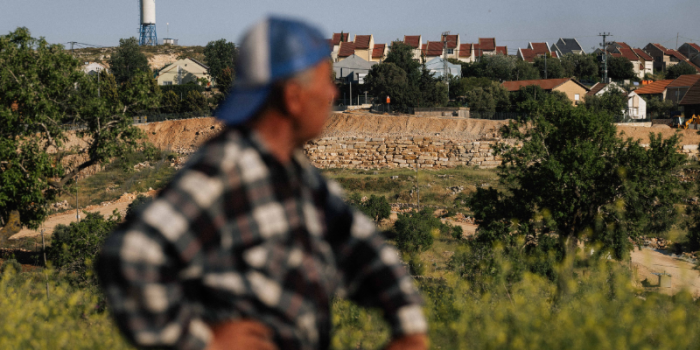
Photo: Dan Vernon
Since 30 March 1976 Palestinians have commemorated Land Day, marking the killing of six demonstrators who were protesting against the expropriation of Palestinian land in the Galilee. Over time, Land Day has become a symbol of Palestinian resistance to Israel’s settler-colonial policies and systematic dispossession of the Palestinian people. Fifty years on, the relevance of Land Day is profound. The events of 1976 mark a point in a continuum of displacement, land confiscation, and demographic engineering that predates 1976 and persists today. Israeli policies of settlement expansion, annexation, property transfer, and demographic manipulation have intensified over decades, culminating in a multifaceted campaign that, today, threatens the very existence of the Palestinian land, life, and identity.
Gaza: Total Destruction and Denial of Return
In the last two years of Israel’s continuing genocidal assault on Gaza, 72,265 Palestinians have been killed and 171,959 Palestinians injured Palestinians, including 689 Palestinians killed and 1,860 injured since the so-called ceasefire in October 2025. Gaza’s physical and social infrastructure has been obliterated. Satellite images show that over 80 percent of Gaza has become uninhabitable. The scale and pattern of devastation indicate the systematic targeting of residential and civilian infrastructure, consistent with long-term objectives of territorial control and demographic reshaping. Israeli officials, advocating for the mass transfer of Palestinians from the Gaza Strip, are now explicitly linked “rebuilding” as a tool to consolidate occupation, advance settlements and permanently annex Palestinian territory. Ongoing demolitions, advancing the so-called “Yellow Line” boundaries and movement restrictions are further fragmenting the Gaza Strip, forcing residents into ever-smaller areas. These measures – when carried out in conditions unfit for human survival amount to continuing acts of genocide.
At the international level, proposals such as the so-called “Comprehensive Plan to End the Gaza Conflict” seek to place Gaza under external administration, excluding Palestinians from meaningful authority over their land and future. Such proposals contravene fundamental norms of international law, including the prohibition on acquisition of territory by force (UN Charter, Article 2(4)) and the right of peoples to self-determination (International Covenant on Civil and Political Rights, Article 1; International Covenant on Economic, Social and Cultural Rights, Article 1).
West Bank: Settlement Expansion and Fragmentation
While Gaza lies in ruins, the West Bank, including East Jerusalem has become the focus of Israel’s accelerating project of annexation. Since late 2024, more than 36,000 Palestinians have been forcibly displaced “on a scale previously unseen”, due to settlement expansion, demolitions and systematic settler violence. Israeli authorities have advanced or approved approximately 27,200 settlement units and established at least 84 new outposts. As explained by the UN Special Rapporteur on the Occupied Palestinian Territory, such “measures are not routine administrative adjustments. They are deliberate, incremental steps toward permanent annexation, advanced piece by piece, in broad daylight, and with total impunity”. These are accompanied by concerted legal, administrative and physical measures, including land registration, designed to achieve territorial control and fragmentation, entrenching Israel’s settler colonial apartheid regime.
Strategic projects, including the E1 corridor, aim to sever territorial continuity and isolate East Jerusalem, eradicating the geographic basis for a contiguous viable Palestinian state and with it its indigenous Palestinian population. A revived land registration process in Area C – the first since 1967 – risks formalizing the transfer of Palestinian land into Israeli control without legal protection or effective remedies for Palestinian owners, creating coercive environments to force land transfer for further colonisation.
Between October 2023 and late 2025, at least 1,221 Palestinians – including 263 children – were killed by the Israeli Occupying Forces (IOF) in the West Bank, with at least 24 additional Palestinians killed in early 2026. During the same period, 1,732 documented incidents of settler violence targeted Palestinian homes, farmland, livestock, and olive groves, including the uprooting of approximately 2,500 olive trees near Ramallah. In recent months, the scale, frequency and coordination of these attacks have reached unprecedented levels. State-backed settler groups, acting with impunity, have escalated attacks on Palestinian communities and critical infrastructure, including water and sanitation systems – forcing displacement and appropriating Palestinian lands. Road closures, checkpoints, and other movement restrictions imposed by the IOF have further isolated Palestinian communities, limiting access to livelihoods, health care and emergency services.
The cumulative effect of the settler colonial apartheid policies constitutes a systematic process of forcible transfer, population displacement and territorial fragmentation, carried out under a regime of annexation. When implemented as part of a widespread and systematic policy against a civilian population, such acts may constitute crimes against humanity, including forcible transfer, apartheid and persecution under the Rome Statute of the International Criminal Court. These practices further violate jus cogens norms of international law, prohibiting the acquisition of territory through the use of force and the denial of self-determination, leading the International Court of Justice to conclude that Israel’s occupation of the Palestinian territory amounts to an illegal presence, which must be brought to an immediate end.
East Jerusalem: Israel’s ‘Regularising’ Acts of Forced Displacement
In East Jerusalem in the West Bank, discriminatory property laws – notably the Absentee Property Law (1950) and the Legal and Administrative Matters Law (1970), and land registration procedures – continue to facilitate the systematic dispossession of Palestinian families. They allow settler organisations to “reclaim” properties based on alleged pre-1948 Jewish ownership, while Palestinians are denied reciprocal rights to reclaim property lost during the 1948 Nakba or the 1967 occupation. Together, these legal frameworks form part of a broader coercive environment that systematically pressures Palestinian families to leave East Jerusalem, contributing to the ongoing reshaping of the city’s demographic composition.
Palestinian families in East Jerusalem face eviction, harassment and coercion, with some forced to demolish their own homes under threat of fines or imprisonment– practices described by UN experts as contributing to the irreversible ‘de-Palestinisation’ of the city. Israel’s apartheid policies, movement restrictions, segregated infrastructure and limited access to healthcare, education and religious sites further deepen segregation. Israeli authorities blocked access to Al Aqsa Mosque during Eid prayers, preventing thousands from reaching one of Islam's holiest sites.
The expansion of armed settler privileges, including broader gun licensing, heightens intimidation, leaving Palestinian communities in Jerusalem exposed to increased Israeli settler violence, in Palestine’s capital city. Together with ongoing demolitions and settlement expansion, these measures are systematically reshaping East Jerusalem’s physical, social and spiritual fabric, threatening the continuity of Palestinian presence in the city. These forced evictions and discriminatory enforcement disrupt not only physical existence but also the collective memory and identity of Palestinian communities, contributing to a larger scheme of forced transfer under international law.
From Impunity to Accountability: The Obligation to Act
The policies and practices outlined above constitute egregious and ongoing violations of international law. In 2024, the International Court of Justice (ICJ) reaffirmed that Israel’s occupation of the Palestinian territory, including East Jerusalem, is unlawful and must end, instructing States not to recognise or support annexation nor provide aid that perpetuates the illegal situation. International law prohibits the acquisition of territory by force, the transfer of population into occupied territory, and the forcible displacement of the protected occupied population. It also affirms the fundamental right of a people to self-determination. These provisions are not abstract; they create binding obligations. Yet despite widespread recognition of the State of Palestine and repeated international condemnation, meaningful action has not followed, and violations continue unabated.
Al-Haq urges the international community to comply with key legal obligations:
-
Reject annexation plans and any initiatives that bypass Palestinian consent or violate international law, including the “Comprehensive Plan to End the Gaza Conflict”, under UN Security Council resolution 2803;
-
Terminate economic, trade, and academic agreements with Israel that support or benefit from occupation, apartheid or genocide, including the EU-Israel Association Agreement; and adopt legislation to prohibit the import of settlement goods and services into national jurisdiction;
-
Impose a full arms embargo on Israel, halting all imports, exports, transfers and dual-use items;
-
Prevent nationals from serving in or materially supporting Israel’s military, settlers, or security forces, including mercenaries; and revoke all entitlements and pensions accrued for dual national citizen settlers living illegally in Palestinian territory;
-
Investigate and prosecute individuals under national and international jurisdiction involved in war crimes, crimes against humanity, and genocide; and cooperate with the International Criminal Court to arrest Israeli Prime Minister Netanyahu and former Minister of Defence, Yoav Gallant;
-
Protect Palestinian civil society and human rights defenders, including independent monitors and international tribunals, from reprisals; including by adopting the EU Blocking Statute to protect human rights organisations against US sanctions.
Today, Land Day is more than a commemoration of the past; it’s an urgent demand for accountability and action. Only sustained international engagement together with Palestinian resilience can uphold justice, self-determination and human dignity.
1. See UN Charter Art. 2(4); Fourth Geneva Convention (1949) Arts. 49, 147; ICJ Advisory Opinion on the Legal Consequences of the Construction of a Wall in the Occupied Palestinian Territory (2004); ICCPR Art.