

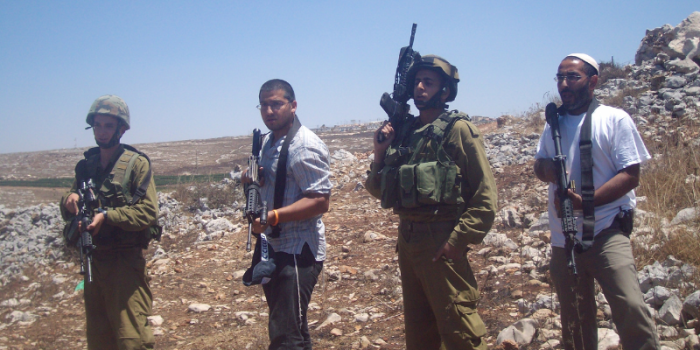
Photo: ISM Palestine
Al-Haq recognises the sanctions against individual Israelis and Israeli entities, announced on 9 June 2026 by Australia, Canada, France, Norway, and the United Kingdom, with the stated purpose: to ‘disrupt the flows of finance that have allowed extremist settler groups to act with impunity in the West Bank’, and ‘to protect the viability of the two-state solution’ by ‘urgent implementation of the 20 Point Peace Plan’. The joint statement, while indicating action against a limited number of individual Israelis and Israeli entities responsible for the maintenance of the unlawful occupation, falls far short of recognising the legal obligations upon Third States.
It is incumbent on Third States to both recognise and address Israeli settler violence as a strategic Israeli state policy, intricately linked to the ongoing genocide against the Palestinian people, and intended to terrorise, dispossess, and displace Palestinian communities across the unlawfully occupied West Bank, including East Jerusalem.
Israeli impunity
Al-Haq recalls that the International Court of Justice (ICJ) had recognised that ‘Israel’s settlement policy has given rise to violence by settlers and security forces against Palestinians’ (Palestine AO, 2024, para. 148) and concluded that ‘Israel’s systematic failure to prevent or to punish attacks by settlers against the life or bodily integrity of Palestinians, as well as Israel’s excessive use of force against Palestinians, is inconsistent with [its international humanitarian law and human rights obligations]’ (Palestine AO, 2024, para. 154).
The impunity accorded to Israeli settler violence is an explicit policy choice of the State of Israel, and is the responsibility of the State of Israel. Settler violence is not a series of individual incidents but rather a widespread and systematic practice facilitated by Israel to pursue the Zionist settler colonial goal of Palestinian erasure. Al-Haq recalls that in their joint statement of June 2025, the UK, Australia, Canada, New Zealand, and Norway recognised that ‘Settler violence has led to the deaths of Palestinian civilians and the displacement of whole communities. […] We have engaged the Israeli Government on this issue extensively, yet violent perpetrators continue to act with encouragement and impunity.’
Since that statement, Israeli military and settler violence has escalated, as Israel pursues its policies of genocide and annexation. In January 2026, the UN’s OHCHR again stressed that: ‘State-backed settler violence has become a key driver of forced displacement, chipping away at Palestinian presence in strategic locations’, while in June the UN’s Commission of Inquiry affirmed that: ‘Settler violence in the West Bank functions as a means of implementing Israeli State policy, with both the State and violent settler groups working towards the same strategic objectives: entrenchment of Israeli settlements, annexation of Palestinian territory and displacement of Palestinians from their land.’
In this context, demands, such as by the UK that Israel must ‘clamp down on settler violence, [and] prosecute those responsible’ appear contradictory, or obfuscatory, given both perpetrator and prosecutor act on behalf of the Israeli state. This is a core feature of apartheid regimes and evidences the need for Third States to act under universal jurisdiction, and for institutions such as the International Criminal Court to be accorded every support it requires to fulfil its mandate. Al-Haq therefore reiterates its calls for all Third States to:
-
Recognise that settler violence is part of an Israeli state policy of apartheid;
-
Investigate criminal acts of settlers, including settler Israeli Ministers, and prosecute those responsible for grave breaches of the Geneva Conventions, war crimes, crimes against humanity, and the crime of genocide; including referral to the International Criminal Court (ICC);
-
Ensure accountability domestically as required under the Rome Statute of the ICC, implementing requirements for the disclosure of service, of those who serve or who have served in the Israeli military, and the disclosure of residence of settlers, upon entry into States;
-
Establish an International, Impartial and Independent Mechanism to assist in the investigation and prosecution of persons responsible for the most serious crimes against the Palestinian people;
-
Implement a full arms embargo on Israel;
-
Activate universal jurisdiction mechanisms in national courts to prosecute perpetrators of international crimes.
Al-Haq has demanded that states ‘act to sanction individual settlers and settler organisations, taking action’ a demand endorsed by the UN General Assembly in 2024, in the context of a range of measures states are to take in order to give effect to the ICJ’s Palestine Advisory Opinion. These measures, which include the realization of the right of the Palestinian people to self-determination, not to render aid or assistance in maintaining the situation created by Israel’s illegal presence in the OPT, ensuring compliance with international humanitarian law, supporting accountability efforts for all victims, and eradicating the violations by Israel of article 3 of ICERD which prohibits racial segregation and apartheid, must be applied comprehensively, and not in a piecemeal and fragmented manner.
Al-Haq calls on States to abide by their international legal obligations, to bring to an end Israel’s settler colonial apartheid regime, genocidal conduct, and to end its unlawful occupation:
-
Implement legislation to end the import into their jurisdictions, and public procurement of all goods and services from settlements, and which maintains the unlawful occupation and apartheid;
-
End all trade with Israel that maintains the illegal occupation and apartheid;
-
Sanction settler organizations, businesses, and those complicit in maintaining their presence in the OPT;
-
Individually sanction all Israeli settlers, commencing with State or public officials, unlawfully present in the Occupied Palestinian Territory;
-
Revoke all pension rights and State benefits to dual nationals who are illegally colonising the Palestinian territory.
Absent from the joint statement is any reference to the right of the Palestinian people to self-determination. Rather, political support for ensuring the viability of a two-state solution is framed as ‘action to support implementation of the 20 Point Plan for Gaza and protect and strengthen a viable Palestinian state.’ Al-Haq has condemned in the strongest terms the US imposition of the 'Comprehensive Plan to End the Gaza Conflict', also known as the '20-point plan'. The ‘20 Point Plan’ advances a model of economic exploitation that treats Gaza not as an integral part of the homeland of the Palestinian people but as a commercial investment zone, echoing the earlier GREAT Trust proposal and the 2020 Trump 'Economic Peace to Prosperity' plan. Presented as a path to peace, the ultimatum – prepared in coordination with Israel, but without Palestinian involvement – enables the permanent fragmentation, de facto annexation and foreign administration of Palestinian territory in breach of the inalienable Palestinian right to self-determination.
Al-Haq reiterates the view of Palestinian civil society organisations, that the UN Security Council’s purported endorsement, by way of Resolution 2803 of the ’20-Point Plan’, the so-called ‘Board of Peace’, and the proposed ‘International Stabilization Force’, is manifestly unlawful. It is Al-Haq’s view that the Resolution is in contravention of Article 24(2) of the UN Charter and must be regarded as null and void. Al-Haq accordingly calls on Third States to reject the implementation of UN Security Council Resolution 2803 and demands, through meaningful action, a lawful and just resolution that:
-
Prioritises the inalienable rights of the Palestinian people, including the rights to self-determination and the right of return of Palestinian refugees and exiles;
-
Dismantles Israel's settler-colonial apartheid regime on both sides of the Green Line;
-
Ends Israel’s unlawful occupation and escalating annexation of Palestine;
-
Calls for the establishment of a UN-mandated and state-supported oversight mechanism over the reconstruction of Gaza, in consultation with representatives of the Palestinian people and with our explicit consent;
-
Imposes diplomatic, military and economic sanctions on Israel, including a three-way arms embargo and energy embargo;
-
Aligns with Third State obligations arising from the International Court of Justice's Advisory Opinions on the Legal Consequences arising from the Policies and Practices of Israel in the Occupied Palestinian Territory, including East Jerusalem (2024) and the Legal Consequences of the Construction of a Wall (2004).