

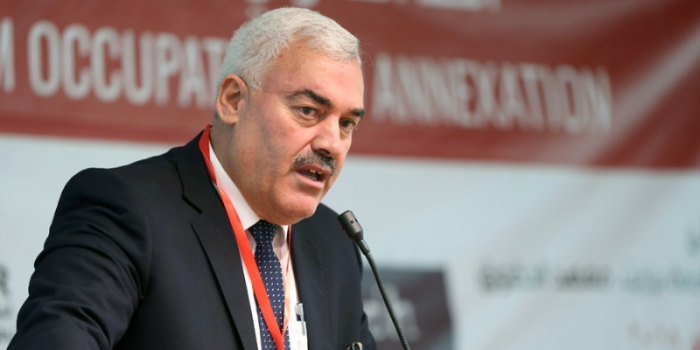
On 30 April 2026, in a significant ruling against arbitrary political measures to silence the crucial advocacy work of Palestinian human rights organisations, Al-Haq’s General Director, Shawan Jabarin won his visa appeal against the French Ministry of Interior.
Mr Jabarin had planned to travel to France for critical high-level briefings at the French Parliament, the Ministry of Foreign Affairs and the Council of Europe, advocating for accountability in the face of Israel’s ongoing genocide of the Palestinian people. On 14 October 2025, the French Ministry of Interior rejected Mr Jabarin’s the short term visa request to enter France, on the grounds that “one or several Member States [of the European Union]” considered him as “presenting a threat to public order”. When Mr Jabarin appealed this decision administratively, his appeal was dismissed by the Ministry of Interior on 17 December 2025.
Notably, prior to the visa denial, Mr Jabarin had been invited as a key speaker in prestigious high level speaking engagements across Europe. On 23 April 2026, Mr Jabarin was hosted by the Palestinian Mission in the Hague in the Netherlands; on 22 April 2026, he was interviewed by members of the Foreign Affairs Committee of the Danish Parliament; and on 23 March, he was invited to speak at the Palais des Nations in Geneva. The so-called spurious grounds of a “threat to public order” was a politically-motivated decision fabricated in an effort to silence Al-Haq and its work.
On 30 April 2026, the administrative tribunal of Nantes delivered an interim relief; ruling that nothing in the present case warranted the conclusion that Mr Jabarin represented a threat to public order. The interim judge noted that Mr Jabarin had been previously granted a short-term visa to France valid from October 2021 to October 2025– a period during which he had visited France on numerous occasions without causing any trouble to public order, including when he was hosted by the President of the Republic of France at the Élysée Palace on 28 October 2022. The interim judge further observed that Mr Jabarin had been invited to address the United Nations General Assembly, and on several occasions had been invited by civil society organisations or international bodies in Europe, adding that he was further invited to attend events next month by two members of the French Parliament.
In a stern rebuke, the judge concluded that the decision of the Ministry of Interior was baseless and not legally valid. The judge held conclusively that “the white note produced [by the government], which is, incidentally, undated, consists of unsubstantiated assertions or conjectures” and that “the contested decision is vitiated by a manifest error of assessment as regards the risks he poses to public order, is, at this stage of the investigation, such as to give rise to serious doubt as to its legality”. On this basis, the French Ministry of Interior was ordered to reconsider the visa denial within 15 days.
Al-Haq strongly welcomes this decision which once again reconciles France with its prior laudable recognition of Al-Haq work –notably when it awarded Al-Haq, among other organisations, the prestigious 2018 Human Rights Prize of the French Republic– an award which was received by Mr Jabarin himself in Paris. Al-Haq has continued its human rights, accountability and advocacy work as Israel advanced the de facto annexation of the West Bank and the genocide of Palestinian people. We did so regardless of smear campaigns and severe sanctions aimed at silencing us, flawed by the same politicisation and lack of proper factual basis.
Unfortunately, political interference to quash Palestinian human rights advocacy is not isolated and mirrors a growing trend in French foreign policy embracing a pro-Israel agenda. For example, the French Ministry of Foreign Affairs recently condemned statements it attributed to Francesca Albanese, the United Nations Special Rapporteur on the Situation of Human Rights in the Palestinian Territories Occupied since 1967, calling for her resignation. It eventually transpired that Ms Albanese never made the statement she was accused of at all, highlighting France’s inability to take fact-based decisions.
More importantly, this Court’s decision ensures France’s compliance with its obligations to prevent genocidal erasure, ensure respect for international humanitarian law, and refrain from aiding and abetting serious breaches of peremptory norms of international law, including the right of the Palestinian people to self-determination.
As Israel and its allies, attempt to sanction and silence Palestinian human rights organisations and activists, now more than ever Palestinian civil society need support from Third States, including France, in their pursuit of accountability for the genocide of the Palestinian people. Acting otherwise would entrench France’s position in undermining efforts toward accountability and advocacy for Palestinian rights, and deepen France’s complicity in targeting those who seek justice.