

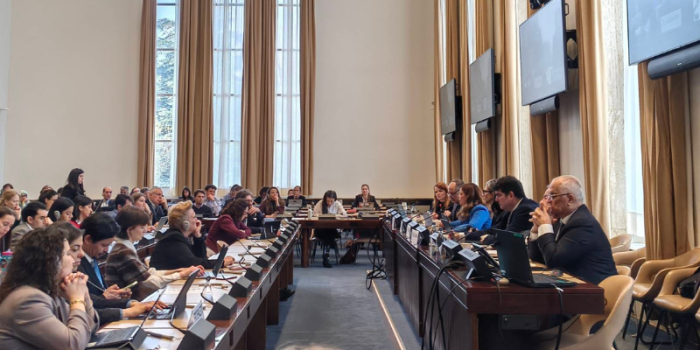
At the 61st Regular Session of the UN Human Rights Council (HRC61), between 23 February and 2 April 2026, Al-Haq built on its advocacy programme from the previous 60th Session held in September 2025, on the inalienable and absolute right of the Palestinian people to self-determination. Al-Haq’s engagement included three written statements and two oral interventions addressing Israel’s ongoing genocide against the Palestinian people; Israel’s accelerating purported annexation of Palestinian territory; the unprecedented rate of State-backed settler violence; and the systematic dismantling of Palestinian civil society. In each submission, Al-Haq underscored the centrality of accountability, the manifest illegality of Israel’s ongoing policies and practices, and the urgent need for States to uphold their binding legal obligations under international law. These core messages and demands were echoed in the various meetings Al-Haq held with States, UN bodies and mechanisms, and international organisations.
Al-Haq's On-Record Engagement at HRC61
Each of Al-Haq’s written statements were submitted jointly with Al-Mezan and the Palestinian Centre for Human Rights (PCHR), sending a strong, unified message to the HRC on the pressing issues facing the Palestinian people, and Al-Haq jointly endorsed a broader concluding statement with international partners.
1. Advancing a “Peace” Framework of Perpetual Occupation and Exploitation
In its written submission for the ‘Panel Discussion on human rights and a culture of peace’, Al-Haq warned against Trump’s ‘20-point Plan’ endorsed by UN Security Council Resolution 2803 – in clear violation of both the UN Charter and peremptory norms of international law. Presented as a pathway to peace, the plan in fact rewards Israel for its ongoing genocidal campaign in the Gaza Strip, enabling the fragmentation, de facto annexation, and perpetual occupation of the Palestinian territory.
The ‘20-Point Plan’ excludes Palestinians from determining their political future, instead imposing governance structures dominated by foreign political and economic actors. Through bodies such as the “Board of Peace” and its Executive Board, the framework institutionalises a model of corporate governance over Gaza, transforming it into a site of economic exploitation rather than the sovereign territory of the Palestinian people.
Al-Haq emphasised that the ‘20-Point Plan’ omits any mechanisms for accountability, thereby reinforcing Israel’s longstanding impunity for international crimes, including genocide. Furthermore, it stressed that States’ involvement or continued silence in the face of its implementation only further normalises the most egregious breaches of international law, thereby undermining not just the Palestinian people’s right to self-determination but the entire international legal order.
2. Israel’s Destruction of Palestinian Property Represents an Ongoing Nakba and Continuing Genocide
In a second written submission, Al-Haq highlighted Israel’s widespread and systematic destruction of Palestinian homes as a central component of an ongoing Nakba and genocide against the Palestinian people.
Across the West Bank, including East Jerusalem, Israeli forces and illegal settlers are escalating attacks that forcibly displace Palestinian communities, particularly in refugee camps and Bedouin areas. Military operations, such as “Operation Iron Wall,” have resulted in the large-scale demolition of homes, mass displacement, and the creation of coercive conditions that prevent return. Al-Haq underscored that such practices constitute grave breaches of international humanitarian law, including the prohibition of forcible transfer, and amount to crimes against humanity and acts of genocide. The ongoing destruction of homes is not incidental damage, but a deliberate strategy aimed towards Palestinian erasure.
3. Israel’s Attacks on Human Rights Defenders Constitute Part of a Pattern of Genocidal Attacks
In its third written submission, Al-Haq contextualised Israel’s escalating attacks on human rights defenders (HRDs) and humanitarian actors within Israel’s broader strategy of repression that is integral to its genocidal campaign.
These measures include restrictive legislation designed to cripple operational ability, administrative barriers, and direct targeting of Palestinian organisations, international NGOs, journalists, and humanitarian workers. The imposition of new registration requirements on international organisations, coupled with bans and sanctions, effectively dismantles the humanitarian infrastructure sustaining Palestinian life amidst an ongoing genocide and escalating assaults across the Occupied Palestinian Territory (OPT).
Al-Haq further stressed the role of third States, particularly the United States, in facilitating this repression through sanctions targeting Palestinian civil society organisations and actors engaged in accountability efforts. These actions aim to silence Palestinian voices and perspectives, inhibit documentation of Israel’s crimes and the complicity of international actors, obstruct justice, and control narratives surrounding Israel’s manifestly unlawful conduct.
4. HRC61 Closes Out with the Delivery of Joint NGO End-of-Session Statement
Al-Haq joined international partners to urge the Council to avoid one-sided framing, adopt a comprehensive, non-selective approach to the conflict and apply objective criteria to all situations and address their root causes, regardless of the perpetrator. One dimension of violence cannot be addressed while silence is maintained on its causes and broader context. The military attacks by the U.S. and Israel across the region are not isolated events, but interconnected acts rooted in a decades-long history of impunity, from the U.S. invasion of Iraq twenty-three years ago, to Israel's genocide against the Palestinian people and air strikes in Lebanon. Across the region, civilian populations are once again paying the highest price, trapped in an escalating war they did not choose and driven by powers that operate above international law. Recognising this lineage is essential to addressing the root causes of ongoing conflict and ending the cycle of impunity.
HRC resolutions on the OPT should adopt a rights-based approach and be implemented to ensure justice and reparations for the Palestinian people. The Council should address the situation in the context of the root causes, including colonial-apartheid and Israel’s ongoing forced displacement and transfer of the Palestinian people. We reiterate our solidarity with Palestinian organisations and human rights defenders worldwide working to uphold international law in the face of Israel’s genocide and colonial apartheid against the Palestinian people. States that continue to provide military, economic, and political support to Israel, while suppressing fundamental freedoms, as well as attacking independent courts and experts, and defunding humanitarian aid (UNRWA), may be complicit in the commission of international crimes.
Al-Haq's oral interventions at hrc61
1. Development as a Vehicle for Exploitation
In its oral intervention under Item 3, ‘General debate on promotion and protection of all human rights, civil, political, economic, social and cultural rights, including the right to development’, on 3 March 2026, Al-Haq crucially addressed the framing of Trump’s ‘20-Point Plan’ as a development and “peace-building” initiative. After exposing it as a mechanism for economic exploitation and a means of entrenching perpetual foreign occupation while normalising Israel’s regional relations, Al-Haq called for the expansion of the UN database of businesses involved in settlement activity to include all actors complicit in the dispossession of the Palestinian people, warning that without accountability, unlawful practices risk being normalised and repackaged as pathways to peace.
As the Trump administration and its allies press forward with the 20-point plan – devised to profit from the destruction of Gaza and the Palestinian people, under the guise of peace, prosperity and development – the Human Rights Council, alongside all UN bodies and Member States, must act with clarity and courage. They must reject Security Council Resolution 2803 as legally invalid based on it violating the UN Charter and peremptory norms of international law, which automatically render it null and void.
It is a profound disgrace that a resolution enshrining the exploitation and perpetual occupation of Palestine was permitted to reach the Security Council – let alone be implemented. There can be no normalisation of annexation, genocide, or the denial of self-determination.
The redevelopment of Gaza, and accompanying economic, social, cultural and political processes, must be determined by the Palestinian people themselves, with international support provided only where and when they deem appropriate. Any US or foreign ultimatum prioritising imperial, capitalist interests that directly obstruct Palestinian self-determination must be unequivocally and repeatedly opposed by the UN and its Member States.
The UN Database of businesses involved in settlement activity must also be urgently updated and expanded to include non-profits, Zionist entities, financial institutions, and all actors complicit in the destruction and dispossession of the Palestinian people.
Without accountability, manifest illegality will continue to be normalised or even repackaged and sold as a path to peace.
2. Rapid Annexation Amidst Ongoing Genocide
In its second oral intervention, delivered in person on 24 March 2026 under Item 7, ‘General Debate on human rights situation in Palestine and other occupied Arab territories’, Al-Haq drew much-needed attention to the various annexationist measures being adopted by Israel in order to expand and entrench its control over Palestine. Recalling the Advisory Opinion of the International Court of Justice (ICJ) of 19 July 2024, Al-Haq evidenced how Israel’s policies and practices continue to defy the authoritative ruling. Moreover, Al-Haq stressed that any attempts to legitimise such acts, including through Security Council Resolution 2803, are null and void under international law.
In direct defiance of the ICJ’s July 2024 Advisory Opinion, and against the backdrop of its ongoing genocide against the Palestinian people, Israel is accelerating its annexation of what little remains of Palestine.
By extending the perimeter of the “Yellow Line”, it is consolidating control over ever-larger areas of Gaza with the clear and stated aim of resettling and exercising permanent sovereignty over the Palestinian territory.
At the same time, sweeping reforms to land registration and the Civil Administration in the West Bank are entrenching Israel’s de facto annexation. Systematic settler violence; rapid settlement expansion; construction of roads linking settlements and outposts to one another - as well as to Israeli cities beyond the Green Line - ; and restrictions on freedom of movement all serve to consolidate Israel’s genocidal, settler-colonial apartheid regime.
In line with Israel’s Zionist agenda, the Palestinian people, along with their land, history, culture, and social fabric, are being erased in real time – and before the eyes of the international community.
Any attempts, such as by Security Council Resolution 2803, to legitimise or shield these manifestly unlawful acts violates the UN Charter and constitutes a grave breach of the Palestinian people’s right to self-determination, rendering them null and void.
All States have a binding obligation to bring this illegal situation to an end and to treat as invalid any measure that purports to normalise Israel’s destruction of the Palestinian people and annexation of their homeland.
Both of Al-Haq’s oral interventions were endorsed by Addameer Prisoner Support and Human Rights Association.
Al-Haq's Side Events at HRC61
1. ‘Defending the Defenders’
At a Side Event organised by No Peace Without Justice (NPWJ), the Coalition for the International Criminal Court (CICC), Al-Haq, Al-Mezan and the Palestinian Centre for Human Rights, and hosted by Colombia, State of Palestine, Slovenia, South Africa, and Spain, Al-Haq delivered a powerful intervention highlighting the escalating use of sanctions and other coercive measures against Palestinian civil society organisations. Speaking alongside Gustavo Gallón, Permanent Representative of Colombia; Francesca Albanese, UN Special Rapporteur on the OPT; Ibrahim Khraishi, Permanent Observer Representative of the State of Palestine; Issam Younis, General Director of Al-Mezan; Raji Sourani, General Director of PCHR; Zoe Paris, Advocacy Coordinator of CICC; and Niccolò Figà-Talamanca, Secretary General of NPWJ, Dr Susan Power, Head of Legal Research and Advocacy at Al-Haq, warned that such measures constitute part of a broader pattern of repression by States engaged in a joint criminal enterprise with Israel aimed at silencing human rights defenders and obstructing accountability efforts.
Al-Haq’s intervention underscored the critical role of Palestinian human rights organisations in documenting abuses and pursuing accountability through international legal mechanisms, including engagement with the UN system. Furthermore, it emphasised that efforts to delegitimise and sanction Palestinian civil society organisations both undermine the rule of law and threaten the protection of fundamental human rights in the OPT. Al-Haq called on States and international bodies to reject such measures, uphold their obligations under international law, and ensure the protection and enabling environment necessary for human rights defenders to carry out their work.
2. ‘Justice after Torture’
In an event organised and moderated by UN Special Rapporteur on the OPT, Francesca Albanese, Al-Haq spoke alongside the General Director of Al-Mezan, Issam Younis, on Israel’s long-standing, widespread and systematic use of torture as a means of committing genocide. Drawing on extensive documentation outlined in the joint submissions by Al-Haq, Addameer, and Al-Mezan, Al-Haq’s intervention underscored a critical yet often overlooked dimension of Israel’s use of torture: the deliberate and widespread infliction of serious mental harm as a form of collective, psychological torture with an intent to destroy the Palestinian people.
Rather than attempting to catalogue every abuse, Al-Haq examined the torture of Palestinians outside custodial settings. It highlighted patterns such as repeated displacement, home demolitions, family separation, and pervasive violence, stressing that their cumulative impact erodes the fundamental conditions necessary for human existence. In this context, Al-Haq asserted that such practices meet the legal thresholds of, inter alia, torture, apartheid, and genocide, concluding:
[T]o ignore the collective, psychological torture inflicted on Palestinians across unlawfully occupied Palestine, and how this fuels Israel’s destruction of the Palestinian people, is simply to misunderstand it. And to misunderstand it is to enable its continuation. If we are truly committed to international law – which enshrines the principle of the universality of human rights – then we must be equally committed to upholding its application in all contexts, and without exceptionalism.
HRC61 took place against a backdrop of escalating annexation of Palestinian territory and intensifying violence against the Palestinian people. As stressed by Al-Haq while present in Geneva, the growing gravity of these acts is purposefully being obscured by the US and Israel’s unlawful attacks across the region, which serve to divert attention from its increasing pursuit of genocidal policies and practices that aim to destroy the Palestinian people.
In this context – marked by international silence on developments such as UN Security Council Resolution 2803 and Trump’s exploitative, illegal ‘20-Point Plan’, alongside persistent inaction in the face of escalating State-backed settler violence and annexation – Al-Haq used its engagement at HRC61 to consistently remind States of their binding obligations under international law. Through informal meetings, side events, and formal submissions, our organisation emphasised the interconnected nature of Israel’s policies and conduct, highlighting how practices such as home demolitions, repression of civil society, and the imposition of coercive governance structures collectively sustain a broader system of domination intended to erase the Palestinian people from their ancestral homeland.
Continued inaction by the international community not only enables these violations, but also engages the responsibility of third States which currently remain complicit in Israel’s mass atrocity crimes. Hence, and in line with the ICJ’s Advisory Opinion of July 2024, Al-Haq repeatedly called for urgent and concrete measures to end the unlawful situation, ensure accountability for international crimes, and uphold the Palestinian people’s inalienable right to self-determination.
Recommendations
To the Human Rights Council:
-
Reaffirm that the Palestinian people’s right to self-determination is a jus cogens norm and operationalise this recognition across all relevant resolutions and mandates, including through rejecting UN Security Council Resolution 2803 as legally null and void and calling on States to not engage with the ‘20-Point Plan’ it enshrines;
-
Strengthen and renew mandates addressing apartheid, settler-colonialism, annexation, and genocide, ensuring resources for investigation and reporting, including the Commission of Inquiry and relevant Special Procedures;
-
Mandate the UN system to support remedies that enable return, restitution, and reparation, consistent with the realisation of the inalienable right of the Palestinian people to self-determination.
To UN Member States:
-
Reject UN Security Council Resolution 2803 as legally invalid, and do not legitimise or engage in the implementation of the manifestly unlawful ‘20-Point Plan’ in any way;
-
Respect and act upon their binding obligations to prevent and punish the crime of genocide and to respect and ensure respect for the Geneva Conventions of 1949, which includes: imposing a full arms embargo; cutting diplomatic and trade relations; imposing comprehensive sanctions; and pursuing accountability;
-
Act in accordance with their legal obligations as outlined in the International Court of Justice’s Advisory Opinion on Legal Consequences arising from the Policies and Practices of Israel in the Occupied Palestinian Territory, including East Jerusalem, by upholding their duty of non-recognition and non-assistance, and cooperate to bring Israel’s unlawful occupation of and illegal presence in Palestine to an end;
-
Call on the UN Security Council and General Assembly to implement economic sanctions and other countermeasures capable of forcing Israel to adhere to its binding obligations under international law and ending its mass atrocities against the Palestinian people;
-
Protect Palestinian human rights defenders and civil society from sanctions and other punitive measures, including by providing safe channels for funding and engagement with UN mechanisms.
To Special Procedures and UN Mechanisms:
-
Label UN Security Council Resolution 2803 as legally null and void based on it violating the UN Charter and peremptory norms of international law;
-
Integrate self-determination as a cross-cutting analytical lens in all reporting on the situation in Palestine and systematically track States’ compliance with their binding erga omnes obligations;
-
Establish a IIIM accountability mechanism for Palestine and closely monitor Israel’s escalating acts of annexation and ongoing policies and practices carried out with the goal of Palestinian erasure.