

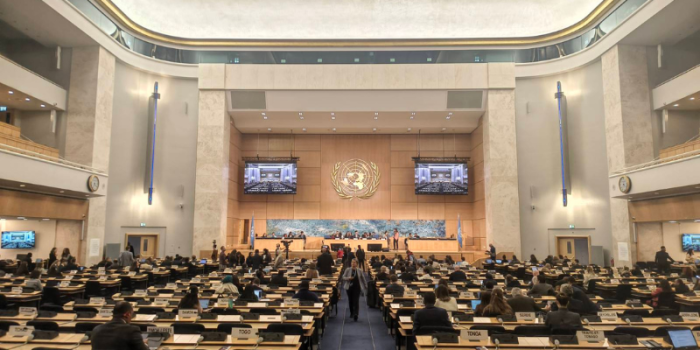
On the “Urgent debate to discuss the recent military aggression launched by the Islamic Republic of Iran against Bahrain, Jordan, Kuwait, Oman, Qatar, Saudi Arabia, and the United Arab Emirates on 28 February 2026” and the “Urgent debate to discuss the Protection of Children and Educational Institutions in International Armed Conflicts: The Aerial Attacks on Shajareh Tayyebeh Girls’ School in Minab, Iran, as a Grave Breach of International Humanitarian Law and International Human Rights Law”, we urge the Council to consistently expose violations by all parties, demand accountability for all violations of international law. This is essential for atrocity prevention, preserving the Council’s legitimacy and the universal application of human rights.
The Council must avoid one-sided framing, adopt a comprehensive, non-selective approach to the conflict and apply objective criteria to all situations and address their root causes, regardless of the perpetrator. One dimension of violence cannot be addressed while silence is maintained on its causes and broader context. The military attacks by the U.S. and Israel across the region are not isolated events, but interconnected acts rooted in a decades-long history of impunity, from the U.S. invasion of Iraq twenty-three years ago, to Israel's genocide against the Palestinian people and air strikes in Lebanon. Across the region, civilian populations are once again paying the highest price, trapped in an escalating war they did not choose and driven by powers that operate above international law. Recognising this lineage is essential to addressing the root causes of ongoing conflict and ending the cycle of impunity.
As regional hostilities have escalated rapidly across the Middle East and threaten to escalate further, we urgently call for all parties to protect civilians and adhere to international law. This includes ending unlawful attacks, such as deliberate, indiscriminate or disproportionate attacks that harm civilians and civilian infrastructure.
In Iran, people face the dual risk of further atrocities at the hands of the authorities, who have shut off internet and communications channels and threatened further massacres of anyone who dares to voice dissent, and U.S. and Israeli strikes on civilians including on Shajareh Tayyebeh Girls’ School in Minab, constituting violations of international humanitarian law.
Iranian strikes have resulted in at least 11 civilian deaths and 268 injuries in GCC countries, with the majority of victims being migrant workers. Iran has struck civilian residential buildings, and civilian airports and unlawfully targeted civilian objects such as financial centers. These are violations of international humanitarian law.
In some of the GCC countries, current hostilities are being used as the opportunity to further crack down on any dissenting voices no matter how peaceful it is. We urge the GCC States not to use the conflict to further silence protected speech.
At a time where the UN Secretary-General has warned of an ‘imminent financial collapse’ as Member States continue to withhold or delay their contributions, the increase in military spending should instead be invested in improving people’s lives through securing their human rights, which - as the UN Charter recognises - are a precondition for peace. As of 24 March, only 94 Member States have paid their regular budget contributions for 2026, leaving the UN unable to function effectively. The U.S. alone owes USD 2.19 billion to the UN’s regular budget, accounting for more than 95 percent of the current shortfall.
Special Procedures have been strongly affected by the UN funding crisis. We caution States that making short-sighted adjustments may lead to longer-term gaps in protection and normative developments. We advise against blanket reductions in Special Procedures’ reporting to the UN General Assembly, and emphasise that any changes should be mandate-specific, in meaningful consultation with all stakeholders, particularly affected communities and mandate holders, provide clear and transparent justification for proposals through a case-by-case analysis and an assessment of the foreseeable gains and losses, as well as the impact on the political visibility of the issues concerned.
We welcome the adoption of a new resolution on the rights of the child, which sets out strengthened measures to prevent and respond to grave violations against children in armed conflict, with a clear focus on accountability, protection, and child-centred recovery. The resolution underscores the devastating and long-term impacts of conflict on children’s rights—including education, health and protection—while calling for comprehensive, gender-responsive support and reintegration. Importantly, it highlights the disproportionate risks faced by girls, including conflict-related sexual violence, child and forced marriage, and barriers to education and healthcare, urging targeted measures to address these harms and ensure their full recovery, dignity and participation.
We welcome the renewals of the consensus resolutions on the right to freedom of religion or belief, and countering hatred based on religion or belief. These texts are foundational in the UN’s work on these intertwined issues, making continued consensus and EU-OIC cooperation extremely valuable. We hope to see States bridge the gap to practice on the ground, through implementation frameworks like the Istanbul Process, as well as ensuring these texts are constructively adapted in light of emerging trends and challenges.
We welcome the resolution to extend the mandate of the Special Rapporteur on the right to freedom of opinion and expression. For over thirty years, the mandate has played an essential role in the promotion and protection of the right to freedom of expression and been a force in the development of progressive international human rights standards. The mandate continues to be innovative in enhancing our understanding of temporary challenges, from freedom of expression in armed conflict, to journalists in exile, to gendered censorship. The mandate is also a guiding light for many journalists, human rights defenders, and other civil society actors who face human rights violations for speaking out. While we understand the growing financial pressures across the UN and appreciate the good will of the core group in responding to these challenges, we are concerned with the reduction in the reporting of the mandate, and underline that this must be an extraordinary, temporary measure.
We welcome the resolution to extend the mandate of the Special Rapporteur on adequate housing. From addressing housing in contexts of climate change, conflict and evictions, to developing specific standards to protect persons experiencing homelessness and poverty; and migrants, the mandate has played a vital role to continue developing the standards to respect, protect and fulfill the right to adequate housing putting dignity and rightsholders at the centre. We regret, however, that the resolution decreases the annual reporting to the General Assembly. The General Assembly is an important space to continue supporting the realisation of economic, social and cultural rights, including the right to adequate housing and we hope this is reconsidered in the next renewal. We also call on States to consider incorporating the Guiding Principles on Resettlement presented during this session.
We welcome the resolution to extend the mandate of the Special Rapporteur on the situation of human rights defenders for three years. The mandate is integral to defenders’ protection and recognition, globally. We also welcome the inclusion of the paragraph noting civil society initiatives to mark the twenty-fifth anniversary of the Declaration on Human Rights Defenders, in particular the Declaration +25, as well as the language on reprisals against mandate holders, situations of armed conflict and occupation and funding cuts having delivered a series of shocks to the human rights defender ecosystem and its ability to provide protection. We regret that one report by the SR to the General Assembly was removed given the current context of increased risks and attacks on human rights defenders and shrinking civic space, there is a need to demonstrate support to defenders and maintain annual reporting to the General Assembly. The General Assembly is an important space to build political awareness, understanding and support for the work of defenders.
We welcome the renewal of the mandate of the Special Rapporteur on contemporary forms of racism, as well as that of the Intergovernmental Working Group on the Implementation of the Durban Declaration and Programme of Action (IGWG on the DDPA), for a period of three years. In the context of the 25th anniversary of the DDPA and the AU Decade for Reparations, we consider these renewals timely, and a necessary step towards a renewed commitment by States to dismantling structural racism. We particularly welcome the inclusion of language ensuring that all public meetings of the IGWG on the DDPA to be broadcast via UN Web TV. We consider this to be a step towards demonstrating a principled commitment to the centrality of civil society in the important work carried out under this mandate, particularly in the context of drafting the Declaration on the Promotion, Protection and Full Respect of the Human Rights of People of African Descent.
We welcome the extension the mandate of the Special Rapporteur on torture for a further three years. This renewal is a critical reaffirmation of the international community’s commitment to preventing torture, supporting victims and survivors, and ensuring continued scrutiny of violations worldwide. We particularly welcome the strong calls on States to cooperate fully with the mandate, prevent reprisals, and implement recommendations, including those of the Committee against Torture. Sustained political and financial support for the mandate remains essential to translate these commitments into meaningful protection on the ground.
We welcome the joint statement delivered by Albania, on behalf of Albania, Chile, Kenya, Kyrgyzstan and the Netherlands, and endorsed by 91 States, renewing political commitment to defend human rights multilateralism. We urge States to take collective steps to uphold the pledges outlined in the statement, including to defend human rights mandates in the context of UN80, secure adequate funding for the human rights pillar, safeguard the independence of UN human rights bodies, ensure safe and meaningful cooperation by civil society, and enhance the Council’s work. In this sense, we also welcome the joint statement delivered by Estonia on the 20th anniversary of the Human Rights Council, and its calls to increase synergies between the Council and other fora and mechanisms, further address root causes, and strengthen the focus on prevention.
We welcome the adoption of a new resolution on the human rights situation in Belarus, renewing the mandates of both the Special Rapporteur and the Group of Independent Experts. The resolution rightly reflects the continued deterioration of the human rights situation in the country, including the persistence of grave violations and the growing use of transnational repression against Belarusians forced into exile. It also continues to draw welcome attention to the complementary process underway at the ILO under Article 33.
We welcome the resolution on Myanmar which unequivocally condemns the Myanmar military’s attempts to legitimise its coup attempt in February 2021 through the unilateral convening of elections that were neither free nor fair nor inclusive. The resolution crucially recognised that, as the military orchestrated the elections in limited geographical territories under its control, it continued airstrikes and violence, resulting in the deaths and injuries of hundreds of civilians and stepped up political imprisonment, including of individuals who criticised these so-called elections. The resolution further renewed the mandate of the Special Rapporteur on Myanmar. With this resolution, the Council signals its support for the people of Myanmar who have overwhelmingly rejected the military’s sham elections. This must now be followed up by all individual Member States with concrete steps to hold the junta accountable and cut off its access to political, financial, and military support as outlined in the resolution and repeatedly recommended by the UN Special Rapporteur on Myanmar. Without this, the carnage in Myanmar will continue, and the human rights and humanitarian catastrophe will continue to escalate, and the States that continue to support the junta will remain complicit.
HRC resolutions on the occupied Palestinian territory (OPT) should adopt a rights-based approach and be implemented to ensure justice and reparations for the Palestinian people. The Council should address the situation in the context of the root causes, including colonial-apartheid and Israel’s ongoing forced displacement and transfer of the Palestinian people. We reiterate our solidarity with Palestinian organisations and human rights defenders worldwide working to uphold international law in the face of Israel’s genocide and colonial apartheid against the Palestinian people. States that continue to provide military, economic, and political support to Israel, while suppressing fundamental freedoms, as well as attacking independent courts and experts, and defunding humanitarian aid (UNRWA), may be complicit in the commission of international crimes.
The extension of the mandate of the Commission on Human Rights in South Sudan (CHRSS) is an important step, but continued and stronger action remains needed as rising violence, inflammatory rhetoric, and ethnic mobilisation increase the risk of a return to large-scale conflict and mass atrocities. The Council, alongside regional actors, should maintain close scrutiny, press South Sudanese parties to resume dialogue, and advance accountability, including through establishing the long-delayed Hybrid Court for South Sudan, as essential steps to protect civilians, break cycles of impunity, and promote sustainable peace. As concerns continue to mount over South Sudan’s relapse into civil war, the Council must keep all options on the table, including convening a special session on the country.
We welcome the full renewal of Syria Commission of Inquiry's mandate as originally established in 2011, thereby reaffirming that the fact finding and reporting mandate has remained unchanged in scope and fully independent in its implementation, notwithstanding its consideration under Item 2. We welcome the inclusion of functions to provide advice, insofar as it contributes to ensuring Syria’s compliance with its obligations under international human rights law, in a way that does not constrain the Commission’s core investigative and reporting functions. We stress concern at the potential review in 2027, reiterating the need for any review to be based on objective criteria on the human rights situation and sustained dialogue with Syrian human rights organisations.
We welcome the adoption of a new resolution on Ukraine, renewing the mandate of the Independent International Commission of Inquiry at a time when the need for accountability remains immense. The resolution also gives welcome attention to the grave situation of children in occupied territories, as Russia continues its campaign of forced russification, indoctrination and militarisation, alongside broader efforts to erase Ukrainian identity.
In his global update, the High Commissioner once more ‘regret[ted] the lack of follow-up by the authorities on previous recommendations and on accountability, to protect the rights of Uyghurs and other Muslim minorities in Xinjiang, and of Tibetans in their regions.’ More than two years since the OHCHR’s August 2022 Xinjiang report found China to be responsible for possible international crimes, including crimes against humanity, the report’s recommendations remain unaddressed and violations unabated. Since, UN human rights bodies have further documented widespread and systematic human rights violations across China, including through the CERD’s adoption of an Early Warning and Urgent Decision, and Special Procedures findings that Uyghur forced labour may amount to forcible transfer and/or enslavement as a crime against humanity. This Council should urgently address its selective impunity on China and adopt a resolution establishing a monitoring and reporting mechanism in line with long-standing calls by Special Procedures.
In light of the human rights crisis in Ethiopia, the stalled transitional justice process, violence in several regions, especially in Amhara and Oromia, and mounting risks of a regional conflict with Eritrea, the Council should urgently strengthen its response by reinstating the International Commission of Human Rights Experts on Ethiopia (ICHREE) or establishing a new independent mechanism. At a time of growing instability across the Horn of Africa, and as grievances stemming from the 2020-2022 war are unresolved, stronger Council action is essential to ensure scrutiny, deter further abuses, and help prevent a regional escalation with devastating consequences for civilians.
The situation in Libya was not sufficiently addressed during this session, despite clear evidence that two years of technical assistance under resolution 56/16 have failed to deliver tangible progress on accountability. While Libya’s UPR outcome was adopted, the authorities rejected a significant number of key recommendations, including those on abolishing the death penalty and establishing a moratorium on executions, ending abuses against migrants and refugees, and closing detention centres associated with torture and killings. Recent developments, including the arbitrary arrest and continued prosecution of civil society activist Al‑Mahdi Abdel Ati and persistent reports of torture and abuse in detention facilities housing migrants and refugees, demonstrate that arbitrary detention, enforced disappearances, torture, repression of civil society, and serious violations against migrants and refugees persist. These ongoing failures underscore the urgent need for stronger scrutiny and engagement from the Council.
We regret that both the High Commissioner for Human Rights and States refused to heed the civil society call that followed widespread violations in relation to the post-October 2025 election protests in Tanzania. NGOs had urged the Council to act on Tanzania’s crackdown, calling for a public briefing by the High Commissioner, followed by a debate. Despite reports of hundreds killed, a continuing crackdown on dissent, and serious concerns about the credibility of the national commission of inquiry, no multilateral action followed. The Council should find ways to increase pressure on national authorities, including to ensure genuine accountability for violations.
We are concerned about the deteriorating human rights situation and erosion of the rule of law in the United States (U.S.), as well as its commission of, or complicity in, grave violations abroad, including in Venezuela, Palestine, Iran, the Caribbean and Pacific. The Trump Administration’s refusal to participate in the UPR undermines a core accountability mechanism and should be condemned by the Council. To prevent a wider erosion of engagement, and in light of extensive evidence of violations at home and abroad, we urge increased monitoring, reporting and scrutiny of the U.S. by Special Procedures and the High Commissioner.
In occupied Western Sahara, civic space remains severely restricted where defenders and journalists, in particular youth, face arbitrary detention, violations of fair trial, ill-treatment, intimidation and reprisals due to their peaceful advocacy for self-determination. The Council should ensure unhindered access for OHCHR and Special Procedures to Western Sahara, urge Morocco to guarantee rights of freedom of expression, peaceful assembly, and association including by releasing all individuals arbitrarily detained and upholding fair trial standards, and ending reprisals, against Saharawi defenders advocating for self-determination.
Signatories:
-
Accion Antirracista (RacismoMX)
-
Addameer for Prisoner Support and Human Rights Association
-
Al-Haq
-
Cairo Institute for Human Rights Studies
-
Casa Marielle Franco Brasil
-
Centro de Estudios Legales y Sociales (CELS)
-
CIVICUS
-
Coalizão Negra por Direitos (Brazil)
-
Egyptian Initiative for Personal Rights (EIPR)
-
Europe Brazil Office
-
Geledes - Instituto da Mulher Negra
-
Gulf Centre for Human Rights
-
Hivos
-
Humanists International
-
ILGA World
-
Instituto Brasileiro de Direitos Humanos
-
Instituto Decodifica
-
Instituto Liberdade e Emancipação - ILÊ
-
International Service for Human Rights (ISHR)
-
Rede de Mulheres Negras de Pernambuco
-
World Organisation Against Torture (OMCT)