

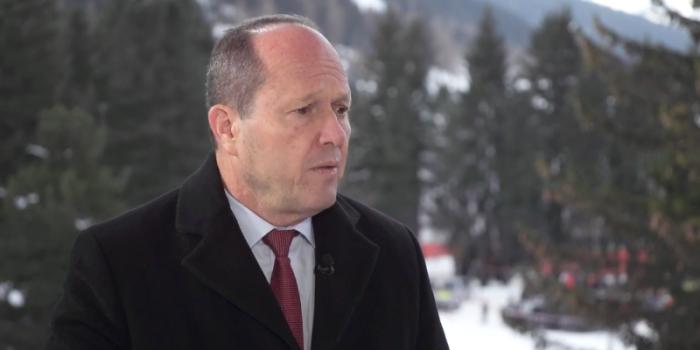
On 22 January 2026, Al-Haq, Al Mezan Center for Human Rights, Association suisse des Avocat es pour la Palestine, and others filed a criminal complaint with the Swiss authorities against Nir Barkat, Israeli Minister for Economy and Industry, and former Israeli mayor of Jerusalem. The complaint identified Barkat’s individual criminal responsibility for a range of international crimes. At the time of filing, Barkat was present at Davos, Switzerland, for the World Economic Forum.
In his role as Minister, Barkat is responsible for the unlawful Israeli appropriation and colonisation of occupied Palestinian territory, the imposition of a criminal regime of apartheid, and is one among many who bear direct criminal responsibility for Israel’s ongoing perpetration of the crime of genocide.
In his previous role, as Israeli mayor of Jerusalem, the complaint charged that Barkat was criminally responsible for a range of settlement-related crimes, including the crime of apartheid. The criminal complaint evidences why Barkat should be investigated for his role in implementing the discriminatory planning regime, city zoning, discriminatory building permits, and racist home demolitions. These acts have contributed to the segregation, fragmentation and forced transfer of the indigenous Palestinian population to maintain Israeli Jewish domination of illegally transferred in settlers in purportedly annexed East Jerusalem.
Our criminal complaint is grounded in Switzerland’s legal framework, which facilitates the prosecution of international crimes where the alleged perpetrator is present in Switzerland. We regret however, that Barkat was permitted to leave Switzerland without having to face accountability for his criminal conduct.
On 11 February 2026, the Office of the Attorney General of Switzerland (OAG) issued a non-initiation order (ordonnance de non-entrée en matière), refusing to open a criminal investigation. That decision purports to claim that Barkat enjoyed immunity based on “special mission” status under the 1969 Convention on Special Missions.
On 23 February, an appeal was filed challenging this position as untenable. In the first instance, for such a status to be plausible, both of the countries sending and receiving a ‘Special Mission’ must be parties to the 1969 Convention. There are relatively few states parties to this Convention, and while Switzerland has indeed ratified the Convention, Israel has not.
In the second instance, the thrust of the progressive development of international law is to the effect that the scope of legitimate immunity attached to state officials does not encompass immunity from prosecution on charges of international crimes. Switzerland itself has, before the International Law Commission, expressed its clear support for affirmation of the legal position excluding ‘the application of immunity ratione materiae to certain crimes under international law.’
The specific crimes which Switzerland believes should be acknowledged as allowing for no such immunity, whether before international tribunals or national courts, are: (a) crime of genocide; (b) crimes against humanity; (c) war crimes; (d) crime of apartheid; (e) torture; (f) enforced disappearance. Switzerland is of the view that the crime of aggression also belongs in this category.
However, despite Switzerland’s interventions to the International Law Commission, it has now created an exception intended to shield Israeli perpetrators from prosecution. In purporting to attach a blanket form of immunity to attendees at the World Economic Forum in Davos, Switzerland is, without legal justification, relying on an unreasonable interpretation and application of the 1969 Convention, to prevent accountability for Israeli perpetrators of international crimes.
Declaring that Barkat enjoys immunity for the allegations against him further places Switzerland in breach of its own accepted obligations under general international law, and specifically Switzerland’s obligation to investigate, and to prosecute or extradite persons within its jurisdiction, suspected of core international crimes. The complaint against Barkat pertains also to violations of the Convention on the Prevention of Genocide. It is notable in this regard that a 1 February 2026 statement on the website of the Swiss Federal Department of Foreign Affairs provided that Convention as an explicit example of an international agreement which ‘provides for a waiver of the immunity of state representatives (for example, the Convention on the Prevention and Punishment of the Crime of Genocide of 9 December 1948).’
Given the urgent importance of ensuring that Switzerland uphold its legal obligations and refrain from creating unlawful procedures for manufacturing accountability gaps, an appeal has now been lodged asking the Swiss Federal Criminal Court to review the immunity reasoning and to require the opening of an investigation.