

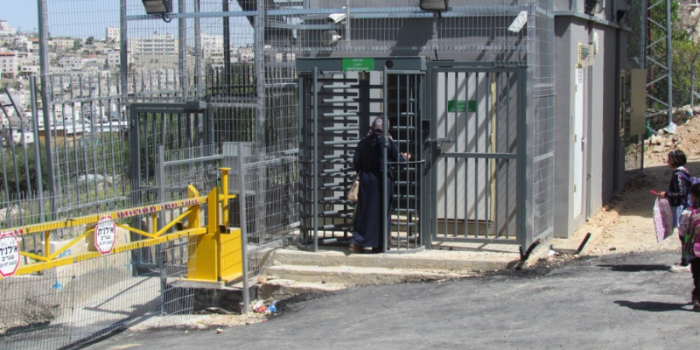
Photo: UNOCHA
On 28 April 2026, Khaled Khiari, United Nations (UN) Assistant Secretary-General for the Middle East, delivered a briefing to the UN Security Council. He stressed that “economic conditions across the West Bank also continue to deteriorate. Rising costs, limited access to employment, and movement restrictions are undermining livelihoods and increasing reliance on humanitarian assistance.”
Since 1948, Israel has implemented discriminatory policies and practices against the Palestinian people in order to fragment and displace the Palestinian people to entrench its settler colonial apartheid regime on both sides of the Green Line. Since 7 October 2023, Israel has added another layer to its systematic de-development of the Palestinian economy by denying Palestinians access to their sources of income from workplaces inside the Green Line, amounting to a collective punishment against the Palestinian people, inhumane acts of apartheid, and continuing acts of genocide. As noted by the International Labor Organization, the “intensification of Israeli movement restrictions, including more than 800 checkpoints and gates” has limited “access to jobs, market and services”: For example, “[s]ince 7 October 2023, average trip durations through key checkpoints near Nablus have increased by 77.9 per cent (an additional 42 minutes), primarily due to rerouting and prolonged wait times”. One can further observe a sharp decline in the number of Palestinians working inside the Green Line from 178,000 prior to 7 October 2023 to only 35,300 by the first quarter of 2025, as Israel revoked Palestinian work permits for employment therein after 7 October 2023.
On International Workers Day, Al-Haq delves into the stories of two Palestinians workers that reflect the above-mentioned conditions, demonstrating how Israel’s restrictions on Palestinians workers are part of a broader scheme aimed at entrenching its domination over and fragmentation of the Palestinian people to destroy the Palestinian group and prevent self-determination.
Bashar Mustafa Asaad Abu Hassan, 28, worked at a car wash in Tamra inside the Green Line. He provided details on Israel’s closure of the crossings, preventing Palestinian workers from reaching their workplaces inside Israel since 7 October 2023. He explained that climbing the wall and crossing to the other side is “extremely dangerous, especially since the Israeli occupation forces constantly monitor the wall and pursue Palestinian workers who try to cross it, leading to arrests, injuries, and sometimes even deaths”. On 16 March 2025, Bashar was arrested by the Israeli police while he was at his workplace, arbitrarily detained, interrogated and subjected to inhuman treatment and punishment. In his statement to Al-Haq, Bashar recalled:
They asked me to show my ID, and I told them I was from Jenin. They asked me for a work permit, and when I told them I didn't have one, they immediately arrested me by handcuffing me. I was taken to an Israeli police vehicle and then transferred to a police station; I believe in Tamra. There, I was interrogated by police investigators about how I entered Israel, my personal life, family details, and other related questions. I remained at the police station for four days, intermittently questioned, during which time I was held in a detention room with other workers.
I was also brought before an Israeli court and sentenced to 31 days in prison for entering Israel illegally. Afterwards, I was transferred to Kishon Prison inside Israel. There, I was placed in a small cell meant for a maximum of two people. However, I was detained there along with three other workers. The cell was too small for that number, especially since it contained only one bed. This forced me to sleep on the floor on an unclean mattress in poor sanitary conditions throughout my detention. The cell had a bathroom but no amenities.
Since the beginning of the Israeli aggression and war on the Gaza Strip, the Israeli occupation and the Israeli Prison Service have imposed collective punishments on Palestinian prisoners and detainees in all Israeli prisons. Televisions, water heaters, and most other belongings have been confiscated, thus doubling the suffering of the detainees and making it unbearable. This is what I experienced and suffered throughout my detention.
Throughout my detention, I received meagre amounts of food. The food ... did not meet daily needs, which is the case for most detainees and prisoners in Israeli occupation prisons. I received only one small container of sweetened yogurt known as "Shmenet" daily. At lunch, I received a small amount of rice or pasta, and sometimes a small piece of chicken or meat, barely enough to feed a small child. Dinners were similar, consisting of a very small amount of labneh or something similar and a tiny piece of bread.
. . . I constantly felt hungry, leading to weight loss, a situation common to other detainees and prisoners. It's worth noting that I only spent a short time in that prison, but for detainees and prisoners who serve long sentences, the effects are clearly visible on their bodies and health, with daily weight loss and a decline in their physical and mental well-being . . . The food provided by the Israeli Prison Service is only enough to keep Palestinian prisoners and detainees alive, if they can even manage to do so.
In that prison, I and other detainees were allowed out into the open yard ("the exercise yard") for only about 30-40 minutes, and sometimes we were deprived of this exercise and exposure to sunlight without any explanation . . . Detainees and prisoners were also deprived of general cleaning materials. As a result of the aforementioned conditions, I contracted scabies during my detention. Scabies is widespread in most Israeli prisons, affecting a large number of Palestinian detainees and prisoners, who receive no treatment from the Israeli Prison Service. Scabies is a skin disease that causes blisters and sores to spread all over the body. It is contagious, and its main cause is neglect . . . I left prison suffering from a widespread rash all over my body . . . The rash caused by scabies is very bothersome and causes constant itching, leading to the spread of more rashes and blisters due to the lack of treatment . . .
Throughout my detention, I was not allowed to communicate with my family, and I wore the same clothes throughout that period.
Bashar also shared his compassion for Palestinians who were held in detention for much longer periods and whose detention conditions were far worse considering that Bashar was arrested and incarcerated for immigration charges as opposed to so-called security-related issues.1
Ammar Ahmad Omar Qasoul, 54, was denied an Israeli work permit until he was 45 due to his prior arrests by Israeli forces during the First Intifada. After 7 October 2023, following Israel’s decision to suspend all work permits, his Israeli employer feared repercussions and sent him and the other Palestinian workers back to the West Bank. As he tried to return to work, his employer asked him to obtain a work permit. Although the employer owed Ammar 13,000 shekels (4,400 USD) for unpaid working days, he told him that he could not pay “because of the war, that he had no money, and that his business was at a standstill.” Ammar was subsequently unable to work for two and a half years, spent all his savings, started accumulating debts and having health issues:
My health deteriorated during this period due to the difficult circumstances, the psychological state, the pressure, and the responsibility. I underwent heart surgery to implant a stent, which was paid for using the prisoners' insurance. The surgery cost 800 shekels, which my brothers collected and paid for me.
Because he had no choice and had to earn money to provide for his family, Ammar crossed and entered the Green Line, which he recounted to Al-Haq as follows:
About four months ago, I started entering through "smuggling" by jumping over the wall in the Ram area. I used to pay 450 shekels to enter, which included climbing the wall and transportation to my workplace. The return trip cost me between 70 and 80 shekels, as the return journey usually went without inspection. I took this risk after reaching a point where I had nothing left to fear...
In Israel, we lived 30 people in a building with water and electricity, but we lived in constant fear of raids by the occupation police. Once, I stayed in the work area for a whole month, and another time for a month and a half. The first time, the occupation forces stormed the place where we were sleeping at 2:00 AM. They took about fifty of us to the police station and detained us for about six hours before releasing us at the Za'im military checkpoint, which separates Ramallah from Jerusalem. This time, there was no beating, only handcuffing.
After my arrest, I tried to cross back two months later, through the same area (Al-Ram). Everyone was afraid and hesitant, but I had no choice. I have a family, no income, and no one to support me... This time, I stayed for about a month and a half, returning home at the beginning of Ramadan this year. After that, I spent about ten days trying to cross into Israel again, but the occupation forces had tightened security at the wall and checkpoints unusually. I heard about workers being injured at the wall and others being arrested inside cars while trying to cross.2
The current situation faced by Palestinian workers, as described above, is a deterioration of an already dire situation prior to 7 October 2023. For decades, Israel has undermined and de-developed the Palestinian economy and thus impeded Palestinian economic development through the exploitation of Palestinian natural resources, withholding tax revenues collected on behalf of the Palestinian Authority and holding Palestinians markets captive. Added to movement restrictions, land confiscations and the settlement expansion imposed and conducted by Israel in the West Bank, including East Jerusalem, this forced de-development has left Palestinians with no other choice but to work inside the Green Line. Such acts of discrimination carried out for the exclusive benefit Israel’s economy while preventing the growth of a sustainable Palestinian economy, are intended to entrench and expand Israel’s apartheid settler-colonial regime. By trapping Palestinians in the cycle of dependency, Israel is undermining Palestinian self-determination. Livelihood is of critical importance for any society’s survival.
In September 2025, the UN Commission of Inquiry concluded that Israel was carrying out acts in breach of the Genocide Convention in Gaza, and that statements made by Israeli authorities are direct evidence of genocidal intent. The intent to destroy the Palestinian group is not limited to Palestinians in Gaza. In April 2025, Israel’s Prime Minister Netanyahu, stated that “The murders of Hamas are just like the Nazis. Like Hitler, they want to kill all Jews and openly declare their intention to destroy the Jewish state. That won't happen. We're determined to destroy the Hamas monsters. There will be no Islamic caliphate on our border – not in the north, not in the south, not in Judea and Samaria [West Bank]”. Israel’s Minister of Energy and Infrastructure (Security Cabinet member) has stated that: “[t]errorism raising its head must be crushed with an iron fist. In Gaza, and in Judea and Samaria, every place where despicable terrorists depart from to harm Jews must be eradicated”.3 The Head of Beit El, settlement in the West Banks, Shai Alon echoed that “the reality within us is no less dangerous and even more than that we have grown and ignored in Gaza . . . The enemy must be felled, uprooted and destroyed without mercy”. Israeli parliamentarian Yitzhak Kroizer addressing the Knesset in March warned “there are no innocent civilians, no innocent children in Jenin”. Israel’s Minister of Finance Smotrich incited that “Al Funduk, Nablus and Jenin need to look like [Gaza’s] Jabalia so that Kfar Saba does not become Kfar Aza, God forbid. . . The terrorism in Judea and Samaria and the terrorism from Gaza and Iran is the same terrorism – and it must be defeated”.
Israeli government Ministers have repeatedly denied the existence of the Palestinian people, in openly genocidal and dehumanizing rhetoric indicating an intent to destroy, while also openly calling for their subjection to deleterious conditions of life, including the denial of movement and livelihood. In February 2024, Israel’s Minister of Finance Ben Gvir warned “[t]here is no Palestinian people . . .I remind you that I have explicitly said that the right to live outweighs the right to freedom of movement of Palestinian residents. The right to live of residents in Judea and Samaria [settlers in West Bank] outweighs the freedom of movement of the residents of the Authority.” Discussing his decision to discontinue work permits to Palestinians, Israel’s Minister of Economy, Nir Barkat explained “We must understand that the Palestinians are training their children to kill Jews . . .That’s the education system, and they pay a million dollars for every Palestinian that kills a Jew.” In a social media post in January 2024, Barkat emphasised, “It's not the role of the Israeli government to be the employment agency for Palestinian workers. The Israeli economy needs working hands from workers from peace-seeking countries, and not from Palestinian workers who will endanger Israeli public security. What was, will not be what will be”, and restating in the Knesset “do not accept workers from the Palestinian Authority, period”.
Israel, as an Occupying Power, must ensure the well-being of the local population. This includes complying with the right to just and favourable conditions of work enshrined in the International Covenant on Economic, Social and Cultural Rights (ICESCR). It has done the exact opposite for decades, by implementing systematic policies and practices discriminating against Palestinians under its control on both sides of the Green Line.
In 2004, the International Court of Justice in its Advisory Opinion on the Wall, concluded that the Wall and its associated regime “impede the exercise by the persons concerned of the right to work, to health, to education and to an adequate standard of living as proclaimed in the International Covenant on Economic, Social and Cultural Rights and in the United Nations Convention on the Rights of the Child” (para. 134). The International Court of Justice in its Palestine Advisory Opinion of 19 July 2024, further concluded that “the entire régime of restrictions on the movement of Palestinians throughout the Occupied Palestinian Territory has a discriminatory effect on their enjoyment of these rights, as well as to the right to be protected from arbitrary or unlawful interference with family life”, and that policies restricting movement amount to prohibited discrimination (para. 206). The Court concluded that Israel’s presence in the OPT breaches peremptory norms of international law, including the prohibition of the acquisition of territory by force, and prohibition of the denial of the right of self-determination, is unlawful and must come to an immediate end.
The level of deprivation documented in this Field Focus is significant and ought to be analysed through the lens of the genocide framework. Indeed, Article 1 of the 1948 Convention on the Prevention and Repression of the Crime of Genocide (“Genocide Convention”) defines genocide as the intentional destruction of a racial, national, ethnic or religious group as such, in whole or in part. One of the genocidal acts listed under the Genocide Convention is “Deliberately inflicting on the group conditions of life calculated to bring about its physical destruction in whole or in part”. Without sources of income, either inside the Green Line or in the OPT, Palestinians cannot secure essential items such as food and water. They cannot afford life-saving medical treatment and buy medicines. Considering the general context faced by Palestinian workers in the OPT under Israel’s effective control, including the economy dependency and annexation, as explained above, the revocation by Israel of works permits for Palestinians inside the Green Line is done with the intent to deprive them of livelihoods, and by the same token, with the intent to erase the Palestinian people, either through conditions of life leading to their destruction or including driving them out of their land under conditions unfit for human survival.
Furthermore, one of our testimonies sheds light on the treatment of Palestinians arrested after entering or trying to enter the Green Line. They were subsequently detained and subject to inhuman deprivation of food, water, clothing and hygiene facilities and items, which is a pattern recently documented by Al-Haq, and that meets the threshold required to amount to torture as well as a genocidal act causing great suffering.
Finally, this deprivation of income also infringes on Palestinians’ collective and fundamental right to self-determination, which is derived into four key components, one of which is the right to economic and social development, as provided by Common Article 1 of the International Covenant on Political and Civil Rights and the ICESCR. Even the remote prospect of Palestinian economic development is severely jeopardized under the current situation in the OPT.
Israel’s relentless multi-layer violations against the Palestinian people, including Palestinian workers, have long been fueled and emboldened by international inaction and complicity. It is incumbent on Third States to immediately take actions required as per the 2024 ICJ Advisory Opinion, as they are under the obligation not to aid and assist the violation of the right of the Palestinian people to self-determination, or to engage in acts of racial discrimination and apartheid, and genocide, in breach of peremptory norms of international law. These norms constitute the very core values of international order and must be defended, which requires Third States to adopt concrete measures against Israel, including a two-way arms embargo, cutting economic and diplomatic ties with Israel, divesting from Israel, and sanctioning corporate actors under their jurisdiction who fail to do so. As Israel’s first trade partner, the European Union incurs a special responsibility and must immediately suspend the EU-Israel Association Agreement.
1 Al-Haq, Affidavit taken from Bashar Mustafa Asaad Abu Hassan, 28, resident of Jenin (18 June 2025), on file with Al-Haq, 2025-06-075-GL-F-A1-IL-NTG.
2 Al-Haq, testimony taken from Ammar Ahmad Omar Qasoul, 54, resident of Kafr ad-Dik (13 April 2026) on file with Al-Haq.
3 Minister of Energy and Infrastructure, Eli Cohen, @elicoh1, Tweet (7:48 am, 15 May 2025), https://x.com/elicoh1/status/1922891899263746448.; South Africa Dossier, para. 72, https://docs.un.org/en/S/2025/560/REV.1