
Photo: Al-Haq
On 19 October 2026, the UN World Food Programme announced that funding shortages had forced it to reduce its monthly food assistance in Gaza from 1.6 million to 1.1 million people, leaving approximately 500,000 Palestinians in Gaza without access to this critical assistance. WFP has also halved food rations, reduced the provision of hot meals from 250,000 to 150,000 per day, and reduced cash assistance for vulnerable families. In May, the World Central Kitchen announced similar cuts in its food assistance programme, with reduced financial capacity forcing it to reduce hot meals in Gaza from one million per day, to half a million ––despite the needs of the people remaining the same.
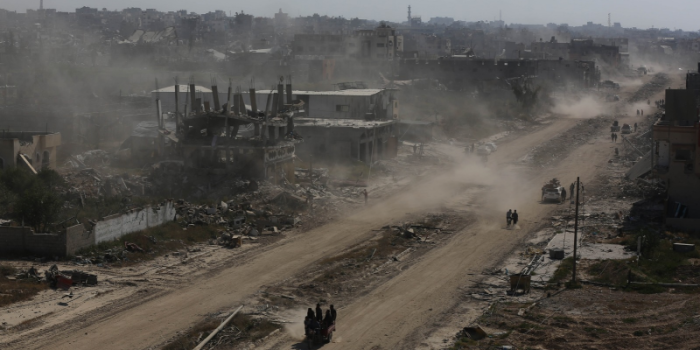
These cuts are taking place while approximately 1.4 million people in Gaza are experiencing acute food insecurity at crisis levels or worse, and approximately 200,000 Palestinians are facing emergency conditions– living in makeshift tents, under Israel’s continued siege and bombardments, denied basic necessities to force their destruction. Israel has blocked vital oil and fuel needed to power generators, with the Gaza Ministry of Health on 21 October warning that hospitals have now run out of crucial supplies. Since the so-called ceasefire, 1,481 Palestinians have been killed and 5,410 injured in intensifying attacks across Gaza –74,370 Palestinians have been killed, and 175, 371 have been injured in Gaza since 7 October 2023,
The dire situation has been further aggravated by Israel’s suspension of commercial goods entering Gaza. On 15 October 2026, Israeli authorities announced that commercial goods would no longer enter Gaza, attributing the suspension to a dispute involving local merchants and alleged charges imposed by Hamas. At the same time, candidates for Israel’s Knesset elections have joined Israeli protestors in physically blocking humanitarian aid convoys into Gaza.
Restrictions on commercial entry must be considered in the broader context of the wider humanitarian consequences of prolonged deprivation and collective punishment under Israel’s apartheid, unlawful occupation, and nineteen-year siege and closure of Gaza, its systematic denial of so-called “dual use” goods into the Gaza Strip, and its blocking and conditioning of essential reconstruction materials on demands for Hamas “decommissioning”. Humanitarian consignments alone cannot substitute for the sustained flow of commercial goods necessary to support civilian life and functioning markets in Gaza.
At the same time, Israel continues to block all access of the UN Relief and Works Agency (UNRWA) into the OPT, in an attempt to force the dismantling of UNRWA and eliminate the protection of Palestine refugees, to continue its annexationist settler colonial enterprise. Israel’s continued attacks on UNRWA, the main artery of humanitarian aid in and around Gaza, are an outright breach of the 22 October 2025 UNRWA Advisory Opinion of the International Court of Justice (ICJ), and the Court’s Orders in South Africa v. Israel for Israel to facilitate humanitarian aid “at scale” into Gaza.
These reductions and restrictions must also be understood within the context of the continuing genocidal conditions imposed by Israel: the destruction of livelihoods, repeated displacement, inadequate shelter, limited access to clean water and sanitation, denial of fuel and reconstruction materials, and persistent barriers imposed by Israel to obtaining sufficient and nutritious food. The withdrawal or reduction of humanitarian aid has immediate and potentially life-threatening consequences for Palestinians. States and donors must urgently ensure that humanitarian agencies, like the WFP, UNRWA and World Central Kitchen can maintain and expand their operations in Gaza.
The prohibition of starvation of civilians is absolute. Starvation with the intention to destroy a protected group amounts to genocide. The ICTY, ICTR and the ICJ have addressed the role of the denial and impeding of humanitarian aid and basic services as acts of genocide, stating that such conditions of life could encompass: “deprivation of food, medical care, shelter or clothing, as well as lack of hygiene”, “subjecting the group to a regime of subsistence . . . the reduction of essential medical services below minimum requirement . . . ”, and generally “creat[ing] circumstances that would lead to a slow death.”
The people of Gaza cannot survive another winter in unsafe shelters, subjected to Israel’s continued attacks while awaiting diplomatic progress. Every delay costs lives, deepening a genocide whose consequences will endure for generations.
-
Ensure the immediate, unimpeded delivery of humanitarian aid: Requiring the opening of crossings, the removal of all restrictions, and ensuring the entry and distribution of food, water, fuel, medicines, medical equipment, shelter materials and other essential supplies “at scale” into Gaza;
-
Demand the entry of reconstruction materials, heavy machinery, engineering equipment, spare parts and other essential items needed to clear rubble safely, repair infrastructure, restore vital infrastructure. The entry of life-saving reconstruction materials, cannot be conditioned on political requirements of decommissioning;
-
Apply military, economic and diplomatic sanctions on Israel. States must end all transfers of weapons, ammunition, military equipment to Israel to prevent genocide under international law and the Arms Trade Treaty;
-
Ensure that recovery is rights-based and Palestinian-centred. Support a reconstruction process that safeguards Palestinian self-determination, facilitates the Palestinian right of return, restores essential services and livelihoods, and protects civilians against forced displacement, dispossession and discriminatory restrictions;
-
Address the root causes of the genocide, by implementing the recommendations of the ICJ Palestine Advisory Opinion of 19 July 2024 to end Israel’s illegal presence in the OPT, and dismantling Israel’s discriminatory settler colonial apartheid regime on both sides of the Green Line.