

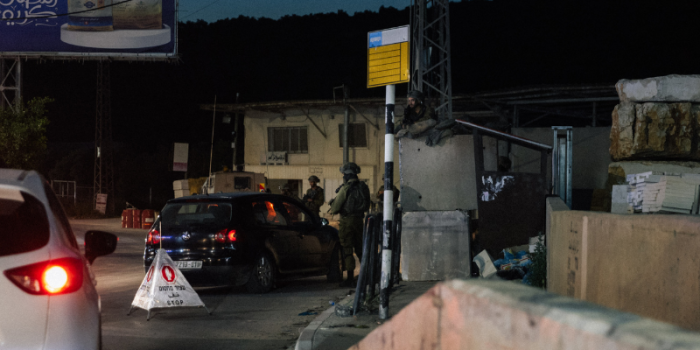
Photo: Dan Vernon
Al-Haq welcomes the significant analysis undertaken by B’Tselem in its new report, “The Elimination Project,” which assists in explaining and contextualising Israel’s escalating violence, with a focus on the illegally occupied West Bank. Crucially, B’Tselem’s report illustrates how, in the present moment, Israel’s policies and practices constitute part of an overarching mechanism of elimination of the Palestinian people.
In aiming to understand the human catastrophe now unfolding in the West Bank, B’Tselem examines the mechanisms of oppression Israel employs against the Palestinian people and the logic of elimination that guides it and the political objectives it serves. B’Tselem’s conclusion that “[a]cross the entire area between the Mediterranean Sea and the Jordan River, one Israeli apartheid regime structures relations between Jews and Palestinians through unequal allocations of status, rights, resources, and political power” echoes Al-Haq’s analyses.
B’Tselem’s report does not approach ‘Elimination’ as a separate legal category, but employs the concept so as to describe and explain Israel’s conduct, noting that the conditions from which the logic of elimination developed can be identified in the Zionist project even before the establishment of the State of Israel. Elimination, in the context of the report, is explained as follows: “In Israel's case, apartheid describes the form of rule; settler colonialism describes its political logic; and the Elimination Project describes the purpose and direction of that logic: expanding Israeli presence and control while dismantling the conditions required for Palestinians to sustain a collective territorial and political existence.” Al-Haq welcomes B’Tselem’s framing of the context as one which correctly centres settler colonialism as the underlying motivation for Israel’s apartheid, as aligned with the positions of the Palestinian human rights movement.
The report turns on two interlocking perspectives: the first examines how Israel acts against Palestinians in the West Bank through five integrated domains of action i.e., violence and intimidation, movement restrictions, economic strangulation, social and political destruction, ethnic cleansing and territorial takeover; the second perspective situates this mechanism within the framework of settler colonialism, a political project that seeks to establish the permanent sovereignty of a settler population in an area inhabited by an Indigenous people by pushing that people aside, dispossessing it, and dismantling its collective existence. In such a manner, Israel’s Elimination Project in the West Bank dismantles Palestinian existence while simultaneously reorganising the space to expand and institutionalise Jewish control and sovereignty.
Observing that this project is not new, but relies on mechanisms Israel has developed and employed for decades, the report notes how: “Since October 2023, violence in the West Bank has escalated in scale, intensity, and pattern. The distinction between soldiers, armed civilians, and settlement security squads has increasingly blurred. From the perspective of Palestinians living under threat, they form one apparatus of violence operating with the backing of the state and military and serving the expansion of Israeli control and the shrinking Palestinian space.”
Al-Haq has consistently stressed the necessity of the struggle against impunity. Indeed, it has been our work demanding that the International Criminal Court exercise its mandate to hold Israeli perpetrators of international crimes accountable, which has prompted the United States to subject Al-Haq and our Palestinian civil society partners to sanctions.
Al-Haq welcomes B’Tselem’s recognition that “impunity is one of the conditions that enable and perpetuate the commission of inhuman acts within the apartheid regime” and the insistence that “Impunity and lack of accountability are integral to the Israeli structure of control and, in practice, enable and encourage the continued commission of inhuman acts of the kind defined in Article II of the Apartheid Convention.”
Third States and international organisations have singularly failed in meeting their obligations to ensure Israel abides by international law. As some Third States commence making piecemeal steps towards targeting certain of Israel’s violence against Palestinians, B’Tselem warns that “more effective enforcement against particularly violent settlers, the removal of certain checkpoints, a partial construction freeze, or changes to discrete policies” may prevent some crimes and violations and protect people in specific instances, “but they do not change the structure that produces violence, dispossession, and oppression”.
Al-Haq endorses B’Tselem’s analysis and calls on Third States to dismantle Israel’s settler-colonial apartheid regime on both sides of the Green Line, to ensure the realisation of the right of self-determination of the Palestinian people as a whole.