

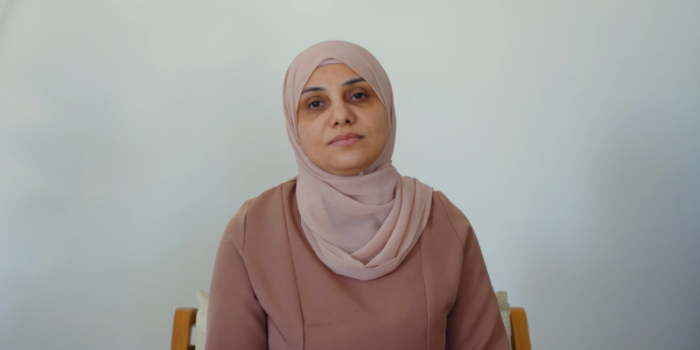
Photo of Sa'eda Ahmad Abu Odeh
I miss the word ‘mum.’ No one calls me mum.Sa'eda Ahmad Abu Odeh, 42
In Geneva, on 25 June 2026, Al-Haq coordinated the participation of Sa'eda Ahmad Abu Odeh, a Palestinian mother from Gaza, at the United Nations side event, “The Maternal Gap: How Systems Fail Mothers and What Must Change”, held at the Palais des Nations during the 62nd session of the UN Human Rights Council. The event marked the launch of the report of the UN Special Rapporteur on violence against women and girls, its causes and consequences on violence against mothers, placing the experiences of mothers at the centre of international human rights discussions.
Representing the lived reality of Palestinian mothers enduring Israel's ongoing genocide in Gaza, Sa'eda delivered a testimony recounting the annihilation of her family and the continuing trauma of survival. Sa'eda is an English teacher with UNRWA and mother of seven children, Sa'eda lost her husband and all seven of her children when an Israeli airstrike struck the UNRWA Al-Shati' school where they had sought shelter after being forcibly displaced.
Opening her testimony, she introduced herself by saying:
I am Sa'eda Ahmad Abu Odeh from Gaza, 42 years old. I am an English teacher with UNRWA. I was a mother for seven children, two sons and five daughters. The oldest one was 20 years and the youngest one was only three years.
She described leaving the classroom where her husband and children were sheltering to search for basic necessities, only to hear the explosion that destroyed the school.
I went to the market just to bring basic necessities for them... I heard a loud explosion. I asked where it was, and I was told it was in the school shelter near the sea where my family were.
Arriving at the school, Sa'eda found it engulfed in destruction before being taken to Al-Shifa Hospital, where she was asked to identify the bodies of her children.
They asked me to identify my children's dead body. It wasn't a moment for recognition. It was a moment that my whole world collapsed in front of my eyes. Imagine a mother being asked to identify these are your children's dead bodies and burned body parts or not.
Reflecting the scale of destruction inflicted on Palestinian families, Sa'eda explained that she considered herself “a lucky mother in Gaza’ because she was able to recover and bury her children's remains, noting that countless mothers continue searching for the bodies of their children.
She described the profound psychological devastation that followed:
It was the end of everything, of life, end of stability, end of safety.
Following the attack, Sa'eda spent four months confined to a classroom in another shelter, unable to speak, leaving only to survive. She was separated from her own mother by Israel's fragmentation of the Gaza Strip, she described how faith became her only source of strength.
Her testimony also highlighted the gendered realities faced by mothers throughout Gaza, describing the impossible choices women were forced to make amid starvation, repeated displacement, and relentless bombardment.
Mothers in Gaza suffered a lot during the war because there wasn't anything to cook, to feed their children... Imagine that you couldn't feed your children and you just start to tell them stories until they sleep because you haven't anything to give them.
She recalled searching for wild herbs to survive and remembered her children asking only for “a quarter of a loaf of bread.”
The violence against Sa'eda's family did not end with the killing of her husband and children. After moving to the south during the temporary ceasefire to reunite with her mother, another Israeli attack struck her brother's family's tent in Deir al-Balah, killing his wife and four of their seven children. Three of their surviving children sustained life-changing injuries. Today, Sa'eda cares for them in Jordan while they undergo medical treatment after her ten-year-old niece lost both legs, her sixteen-year-old niece lost an eye, and her nephew permanently lost the use of his arm.
Only weeks later, overwhelmed by successive losses, Sa'eda's mother died after suffering a stroke.
Describing life after the destruction of her family, Sa'eda told the participants:
Because of this genocide, I miss every single moment of everyday life. I miss the word ‘mum.’ No one calls me mum. I miss their shouting, their voice, their faces. I lost my entire life.
Her testimony illustrated that violence against mothers extends far beyond the immediate loss of children. It encompasses the destruction of family life, displacement, starvation, denial of healthcare, psychological trauma, and the systematic dismantling of the conditions necessary for motherhood itself.
The Special Rapporteur's report represents a landmark recognition that violence against mothers constitutes a distinct human rights concern requiring greater international attention. Sa'eda's intervention demonstrated how the realities experienced by Palestinian mothers exemplify the report's findings, while also exposing the specific gendered harms inflicted through Israel's ongoing genocide. The systematic killing of children, destruction of reproductive healthcare infrastructure, attacks on maternity care, forced displacement, starvation, and the devastation of family structures reveal reproductive violence as an integral component of the broader assault on the Palestinian people.
Concluding her intervention, Sa'eda called on the international community to move beyond expressions of concern and fulfil its legal and moral obligations.
The silence of the world is the complicity of the genocide that happened in Gaza. The world must act, not still watch, because we are not numbers and we are not headlines. We don't ask for sympathy. We ask for justice and humanity. We ask for protection that every human being deserves.Sa'eda Ahmad Abu Odeh
By facilitating Sa'eda's participation, Al-Haq sought to ensure that Palestinian mothers' voices directly informed international discussions on violence against mothers and accountability for atrocity crimes. Her testimony stands as a powerful reminder that behind every statistic is a family, a mother, and a life irrevocably changed.
Al-Haq reiterates its call for immediate international action to end Israel's ongoing genocide against the Palestinian people, ensure accountability for all international crimes committed in the occupied Palestinian territory, and recognise the gendered and reproductive dimensions of these violations. Justice for Palestinian mothers requires not only recognition of their suffering, but concrete action to end impunity and uphold international law.