

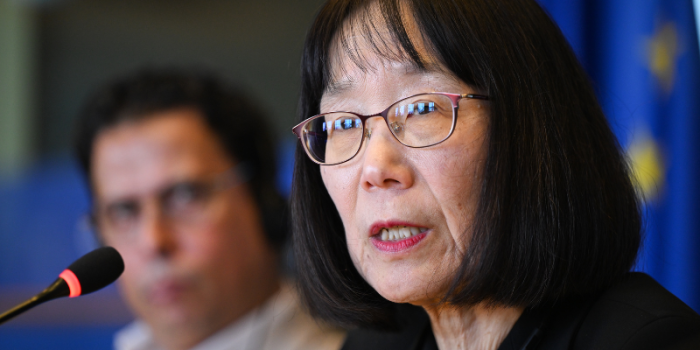
Photo: President of the ICC Judge Tomoko Akane © European Union, 1998 – 2026
On 18 August 2026, the United States (US) again escalated its repressive sanctions campaign against international justice, targeting those it deems to have assisted the International Criminal Court (ICC) in proceedings related to the US or its allies, including Israel, by sanctioning two additional personnel at the International Criminal Court.
In addition to Palestinian civil society organisations, the US has sanctioned the UN’s Special Rapporteur on the Situation of Human Rights in the Occupied Palestinian Territory, the ICC prosecutor, two ICC deputy prosecutors, and nine of the ICC’s 18 judges.
In this instance the US has targeted Judge Tomoko Akane, President of the ICC’s Appeals Division, and Abdoulaye Seye, a senior lawyer with the Office of the Prosecutor, who has acted on the team which sought arrest warrants in the Situation in the State of Palestine, and who has been nominated for election as an ICC judge.
Rejecting the US sanctions designations, the ICC stated that: ‘When judicial actors are threatened for applying the law, it is the international legal order itself that is placed at risk. Threats and coercive measures also impact the ability of victims to seek justice, as they turn to the Court when all other avenues have been exhausted.’
The UN’s Special Rapporteur on the independence of judges and lawyers described the latest sanctions as ‘a shocking betrayal of the Nuremberg promise and a violation of the human rights guarantee of fair trial and access to justice.’
The ICC’s Assembly of States Parties responded by noting its concern at ‘regrettable attempts to impede the Court and its personnel in the exercise of their mandated functions to investigate and adjudicate cases involving the worst crimes known to humanity’. Such meek responses indicate a failure to proactively defend the ICC, and the ASP remains unwilling or unable to demonstrate any practical action to either deter US attacks or to protect the Court and its personnel.
While Israel has welcomed the US conduct, states’ diplomatic responses to the new sanctions predominantly indicate an inability or unwillingness to defend the ICC, suggesting such attacks are ‘unfortunate’ or proffering hollow ‘regrets’. Notably, as the host state of the ICC, the Netherlands must do more than ‘disapprove’ of the US attacks and must urgently act to meaningfully protect the Court, its personnel, and civil society.
Reacting to the sanctions imposed against Al-Haq and partner Palestinian organisations in 2025, (also, as in the present sanctions, under USA Executive Order 14203) Al-Haq warned that: ‘These are attacks on the entire human rights movement globally and an attempt to silence victims of genocide and organisations documenting crimes against Palestinians. It is part and parcel of Israel’s apartheid, genocide and campaign of erasure against the Palestinian people.’
The rationale presented for justifying these sanctions is that the ICC has sought to exercise jurisdiction over nationals of states which are themselves not states parties to the Rome Statute which established the Court. We recall that all states, including the State of Palestine, have the sovereign right and obligation to prosecute any individual responsible for the perpetration of international crimes within their jurisdiction. The inability or unwillingness of too many states to ensure such prosecutions are undertaken was the very reason for the establishment of the ICC.
Today, as the ICC has finally taken steps to exercise its mandate and prosecute individual Israelis responsible for the perpetration of international crimes in Palestine, the USA threatens to ‘systematically dismantle the ICC’ unless it and its allies are guaranteed impunity for their unlawful conduct.
Al-Haq once again calls on all states, including States Parties to the ICC, to urgently amend their conduct and to take practical, meaningful, and immediate steps to protect the ICC. The US campaign to neuter the Court, and to ensure impunity for it and its allies, constitutes a grievous assault on basic human rights and on the international legal framework. The increase in states declaring that they will withdraw from the ICC, alongside the politicised proceedings resulting in the removal of its Chief Prosecutor, demand diplomatic and practical action to protect the institution designed to protect us all.
Al-Haq demands that:
-
The European Union urgently amend the Annex to the Blocking Statute to include US Executive Order 14203 in the list of laws, regulations and other legislative instruments to which the regulation applies;
-
All states parties publicly declare their opposition to US sanctions, demand that the US immediately rescinds all such sanctions, and assert their firm and active support for the ICC’s exercise of its mandate across all situations;
-
All states commit to the meaningful application of universal jurisdiction so as to hold to account all individuals responsible for Rome Statute crimes being perpetrated against Palestinians;
-
All states and international organisations explore avenues to effectively protect Palestinian civil society and human rights defenders, in addition to UN mandate holders, and the ICC, its officials, and those cooperating with the ICC, from the effects of current and potential future sanctions, including by adopting protective measures at the national level;
-
All states impose meaningful diplomatic and economic sanctions on Israel, in addition to a full arms embargo, to end its genocide against the Palestinian people;
-
Those states which have declared an intention to withdraw from the Rome Statute must reverse that intention and reinforce their commitment to the ICC.