

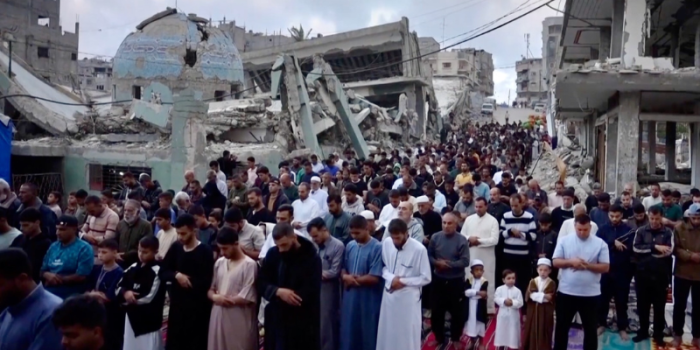
Civilian suffering in Gaza since 7 October 2023, and before, has been epitomised by repeated reports of deaths, injuries, displacement, destruction and humanitarian crisis, affecting virtually every aspect of daily life. Among the most distressing manifestations of the ongoing genocide is Israel’s routine targeting of civilians. Israel has intensified attacks during religious and cultural occasions that traditionally symbolize peace, family unity, and communal resilience. Israel’s recent killings of at least 32 Palestinians in Gaza, during the Eid al-Adha holiday1 further exemplifies this tragic reality, in attacks carried out during one of the most sacred periods in the Islamic calendar, which a large majority of the Palestinian population in Gaza celebrate.
Gaza’s Ministry of Health reported that 119 Palestinians were killed in May 2026, marking the highest monthly death toll since the beginning of the year, with women, children, and the elderly making up 30 percent of the fatalities. The Ministry detailed that 19 children (16%) and 10 women (8.5%) were among those killed. Since the so-called ceasefire took effect on October 10, a total of 1,021 Palestinians have been killed and 3,249 injured, in addition to 781 bodies recovered from under the rubble. According to UN OCHA the overall death toll since 7 October 2023, has reached 73,032 Palestinians killed, and 173,357 Palestinian injured.
Various United Nations, humanitarian and media reporting during recent escalations in Gaza have documented civilian casualties occurring during periods coinciding with, or immediately surrounding Eid al-Adha celebrations. Responding to the Eid al-Adha killings, Ajith Sunghay, Head of UN Human Rights in the Occupied Palestinian Territory (OPT), stated: “It is difficult enough to navigate life in chronic displacement in the ruins of Gaza, under blockade, and after Israeli attacks virtually destroyed every essential system: healthcare, education, food production, law enforcement and civil order. Continuing military attacks on a population living under these conditions is unthinkable.”
The timing of violence during religious holidays conducted during periods of heightened civilian gathering raises important questions regarding the foreseeability of civilian presence, the adequacy of protective measures, and the broader humanitarian consequences of Israel’s attacks. Beyond legal considerations, the occurrence of violence during Eid al-Adha carries profound psychological, social, and cultural implications. Religious holidays serve as moments of collective belonging, remembrance, and emotional refuge, particularly for Palestinians in Gaza enduring a continued genocidal onslaught. When death and destruction intrude upon these occasions, the resulting harm extends beyond the immediate loss of life, disrupting communal rituals, intensifying grief, and reinforcing cycles of collective trauma. For many families in Gaza, celebrations intended to foster hope and solidarity have instead become associated with mourning and loss.
This paper examines the recent civilian killings in Gaza during Eid al-Adha to evaluate whether the timing of such incidents has legal relevance and contributes to aggravated humanitarian and psychological harm. Although international law evaluates such incidents according to established legal standards applicable at all times, the symbolic timing of violence may aggravate the suffering experienced by affected communities and deepen the long-term social and psychological consequences of Israel’s genocidal onslaught.
Israel’s presence as an Occupying Power in Gaza has been found by the International Court of Justice in Legal Consequences arising from the Policies and Practices of Israel in the Occupied Palestinian Territory, including East Jerusalem (Palestine Advisory Opinion) in July 2024,2 to be unlawful and must come to an end as rapidly as possible.
Primarily, the legal assessment of civilian killings during a belligerent occupation is governed by the rules and principles of International Humanitarian Law (IHL), which regulate the conduct of hostilities and seek to limit the effects of armed conflict on civilians.3 Central to this framework is the principle of distinction, which obliges parties to a conflict to distinguish at all times between civilians and combatants and to direct military operations only against legitimate military objectives. Also applicable is the principle of proportionality, which governs the conduct of military operations and prohibits attacks expected to cause incidental civilian harm that would be excessive in relation to the concrete and direct military advantage anticipated. Furthermore, parties to a conflict are required to take all feasible precautions to minimize civilian casualties and damage to civilian objects before launching an attack. These principles are firmly established in customary international law and are reflected in Articles 48, 51, and 57 of Additional Protocol I to the Geneva Conventions.4
Under Article 8 of the Rome Statute of the International Criminal Court (ICC), serious violations of IHL, including intentionally directing attacks against civilians5 or launching disproportionate attacks,6 constitute war crimes7. Depending on the scale, nature, and pattern of the conduct, such acts may also amount to crimes against humanity under Article 7 of the Rome Statute, when they form part of a widespread or systematic attack directed against a civilian population.
Where attacks are carried out with the intent to destroy the civilian population, these attacks and killings amount of genocide.8 Genocide is characterised by the existence of a dolus specialis, the specific intent to destroy, in whole or in part, a protected group as such, demonstrated through a pattern of conduct that includes killings, serious bodily or mental harm, and the deliberate infliction of conditions of life calculated to bring about physical destruction.9 This intent may be inferred from the scale, systematic nature, and cumulative impact of repeated acts, particularly where civilian infrastructure essential to survival is targeted.10 In this regard, the International Court of Justice (ICJ) in its 2024 provisional measures order in South Africa v Israel found that at least some of the alleged acts carried out by Israel in Gaza were plausibly capable of falling within the Genocide Convention,11 triggering inter alia Israel’s legal obligation to take all measures within its power to prevent genocidal acts as enumerated in Article II of the Genocide Convention.
In particular, Al-Haq has highlighted the systematic destruction of Gaza’s healthcare system and the impact of evacuation policies as contributing evidence of conditions of life incompatible with survival.12 Most significantly, the UN Independent International Commission of Inquiry concluded in 2025 that Israel has committed genocide in the Gaza Strip, based on a comprehensive assessment of intent and patterns of conduct under international law.13 Taken together, these legal findings support the characterization that the overarching applicable legal framework is the Genocide Convention.14
Legal analysis
From a legal standpoint, IHL does not establish a special regime of protection for religious holidays. The legality of an attack is therefore not determined by whether it occurs during Eid al-Adha, Ramadan, Christmas, or any other religious occasion. Instead, the legal assessment remains focused on the conduct of the parties and the circumstances of the attack. Questions relating to the military nature of the target, the presence of civilians, proportionality and precautions in attack, are critical in determining whether an attack complies with IHL. However, although IHL does not designate religious holidays as specially protected periods, its underlying purpose is the preservation of fundamental humanitarian principles during armed conflict. Civilian harm inflicted during sacred occasions directly engages this humanitarian objective by undermining the social, and cultural foundations of communities. This is even further exacerbated for those subjugated under a repressive settler colonial apartheid regime and unlawful occupation.
Genocide, on the other hand, requires proof of a special intent (dolus specialis) to destroy, in whole or in part, a protected national, ethnic, racial, or religious group as such.15 As previously mentioned, this special intent distinguishes genocide from other international crimes and may be inferred from the broader context and pattern of conduct, including the systematic targeting of a protected population, the scale of destruction, the repetition of harmful acts, and the foreseeable consequences of those acts. In this context, attacks carried out during Eid al-Adha are relevant because of what such timing reveals about the purpose and effect of the conduct. Eid is one of the most significant religious and social occasions for Palestinians, centred on family gatherings, and communal worship. Israel’s deliberate exploitation of the Eid al-Adha holiday to carry out attacks against Palestinians in Gaza, constitutes evidence of the discriminatory, persecutory, and inhumane character of the conduct, indicative of an intention to destroy the group.16
Aside from legal factors, attacks during Eid have significant humanitarian and psychosocial impacts. Religious holidays signify times of communal gathering, spirituality and celebration. For Palestinian communities in Gaza experiencing total destruction, loss, displacement, and uncertainty amidst the ongoing genocide, these holidays offer the chance for emotional respite and the maintenance of family and social unity.17 When violence takes place during religious and cultural holidays, the ensuing damage reaches well beyond immediate physical injuries.
At a collective level, civilian deaths during religious holidays can also weaken cultural resilience and intensify communal grief. Eid al-Adha occupies a central place in the social fabric and religious life of Muslim communities, and the loss of family members during such occasions carries a symbolic weight that extends beyond individual suffering and targets the heart and soul of a society, and the ability of its population to endure and reconstitute itself. As summed up by the ICRC’s Fabrizio Carboni, where “lives, health, and dignity are lost. Long-term psychological trauma also runs deep”. In Gaza, civilian harm inflicted during sacred occasions destroys the social, cultural, and emotional foundations of Palestinian life, representing a continuing genocide.
Beyond the legal framework, violence occurring during Eid carries an amplified humanitarian impact. By disrupting moments of family unity and religious observance such violence deepens psychological trauma and compounds the suffering of Palestinians already affected by Israel’s decades long settler colonial apartheid regime, and prolonged unlawful belligerent occupation.
Genocidal intent is rarely evidenced directly and is instead inferred from the totality of conduct and its foreseeable effects on the protected group. Conduct occurring during periods of intense religious and communal significance may therefore assist in illuminating whether the broader pattern of violence is directed at the group “as such,” particularly where it contributes to the breakdown of the group’s collective life and continuity. Israel’s attacks killing 32 Palestinians during Eid al Ahda, amount to a continuing destruction of the Palestinian people including through the infliction of serious mental harm.
Al-Haq calls on the international community to bring Israel’s continuing genocidal attacks to an end. In. particular, Al-Haq calls on Third States to apply full sanctions and countermeasures on Israel including a three-way arms embargo, diplomatic and economic sanctions. Further Al-Haq urgently calls on Third States to implement the recommendations of the ICJ’s 2024 Palestine Advisory Opinion, and bring Israel’s unlawful settler colonial apartheid regime and unlawful presence to an end as rapidly as possible. Given Israel’s protracted aggravated breaches of the United Nations Charter, Al-Haq calls for Israel’s unseating from the United Nations General Assembly.
1 United Nations Office for the Coordination of Humanitarian Affairs (OCHA), Humanitarian Situation Report | 5 June 2026 (Jerusalem: OCHA occupied Palestinian territory, June 6, 2026)
2 ICJ, Legal Consequences arising from the Policies and Practices of Israel in the Occupied Palestinian Territory, including East Jerusalem, Advisory Opinion, I.C.J. Reports 2024, p. 753, para. 285(3) and (4), https://www.icj-cij.org/sites/default/files/case-related/186/186-20240719-jud-01-00-en.pdf
3 ICRC, Distinction: Protecting Civilians in Armed Conflict. Geneva: ICRC, 2020.
4 Protocol Additional to the Geneva Conventions of 12 August 1949, and Relating to the Protection of Victims of International Armed Conflicts (Additional Protocol I), adopted June 8, 1977, entered into force December 7, 1978, 1125 UNTS 3, arts. 48, 51, and 57.
5 See Article 8(2)(b)(i), Statute of the ICC.
6 See Article 8(2)(b)(iv), Statute of the ICC.
7 Rome Statute of the International Criminal Court, adopted July 17, 1998, entered into force July 1, 2002, 2187 UNTS 90, arts. 6–8.
8 Article II of the 1948 Convention on the Prevention and Punishment of the Crime of Genocide; Article 6, Statute of the ICC.
9 Al-Haq, Legal Brief I: Special Intent (Dolus Specialis) Required to Classify Acts as Genocide (May 12, 2025), https://www.alhaq.org/cached_uploads/download/2026/04/24/genocide-series-legal-brief-i-special-intent-dolus-specialis-required-to-classify-acts-as-genocide-al-haq-1777033863.pdf
10 Al-Haq, Legal Brief I: Special Intent (Dolus Specialis) Required to Classify Acts as Genocide (May 12, 2025), https://www.alhaq.org/cached_uploads/download/2026/04/24/genocide-series-legal-brief-i-special-intent-dolus-specialis-required-to-classify-acts-as-genocide-al-haq-1777033863.pdf, p. 8-9.
11 Application of the Convention on the Prevention and Punishment of the Crime of Genocide in the Gaza Strip (South Africa v. Israel), Provisional Measures, Order of 26 January 2024, I.C.J. Reports 2024, p. 3 https://www.icj-cij.org/sites/default/files/case-related/192/192-20240126-ord-01-00-en.pdf?utm_source=chatgpt.com, para. 54.
12 Al-Haq, The Systematic Destruction of Gaza’s Healthcare System: A Pattern of Genocide (23 January 2025), https://www.alhaq.org/cached_uploads/download/2025/02/22/destruction-of-gaza-healthcare-system-one-page-view-2-1740217809.pdf; Al-Haq,
How to Hide a Genocide: The Role of Evacuation Orders and Safe Zones in Israel’s Genocidal Campaign in Gaza (1 January 2025), https://www.alhaq.org/publications/25781.html
13 UN HRC, Legal analysis of the conduct of Israel in Gaza pursuant to the Convention on the Prevention and Punishment of the Crime of Genocide, A/HRC/60/CRP.3 (16 September 2025), https://www.ohchr.org/sites/default/files/documents/hrbodies/hrcouncil/sessions-regular/session60/advance-version/a-hrc-60-crp-3.pdf
14 United Nations General Assembly, Convention on the Prevention and Punishment of the Crime of Genocide, adopted December 9, 1948, entered into force January 12, 1951, 78 UNTS 277
15 Article 2, Genocide Convention (1948).
16 Al-Haq, Legal Brief I: Special Intent (Dolus Specialis) Required to Classify Acts as Genocide (May 12, 2025), https://www.alhaq.org/cached_uploads/download/2026/04/24/genocide-series-legal-brief-i-special-intent-dolus-specialis-required-to-classify-acts-as-genocide-al-haq-1777033863.pdf, p. 8.
17 Tun, Hein Minn et al. “Understanding the mental health impact of internally displaced persons (IDPs) and their support networks in southeastern Myanmar post-military coup: a qualitative study.” Conflict and health vol. 19,1 92. 19 Dec. 2025, doi:10.1186/s13031-025-00730-9