

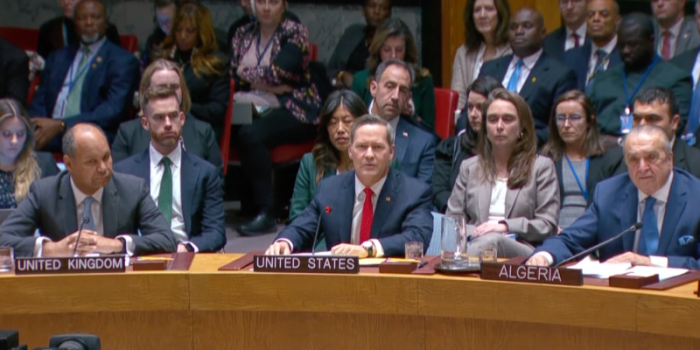
The Palestinian Human Rights Organizations Council (PHROC), has sent letters to Albania, Indonesia, Kazakhstan, Kosovo and Morocco warning that their participation in the ‘Board of Peace’ and planned deployment of armed forces to occupied Palestine as part of a so-called ‘International Stabilization Force’, risks breaching jus cogens norms of international law.
The central initiatives foreseen in UN Security Council Resolution 2803, namely the Board of Peace and its International Stabilization Force (ISF), are themselves inherently unlawful and illegitimate, and the Resolution as a whole must be regarded as null and void. PHROC warns that Albania, Indonesia, Kazakhstan, Kosovo and Morocco’s proposed participation in the ISF risks those forces becoming legally responsible for complicity in a range of ongoing Israeli violations of international law, not least the crimes of apartheid and genocide. We stress that the Trump Plan – despite its marketing as a peace plan – is in effect an ultimatum jointly prepared with Israel, without Palestinian involvement. The Trump Plan has been unlawfully and coercively imposed under conditions of genocide and duress, for the purposes of ensuring the permanent fragmentation, de facto annexation and unlawful foreign administration of Palestinian territory in breach of the inalienable Palestinian right to self-determination.
In July 2024, the International Court of Justice (ICJ) handed down an Advisory Opinion finding Israel’s presence in the Palestinian territory illegal and in breach of peremptory norms of international law, including the prohibition on the acquisition of territory by force and the right to self-determination. The ICJ, in a decision endorsed by the UN General Assembly, demanded an immediate and unconditional end to Israel’s occupation. Rather than complying with this legal obligation, the Trump Plan entrenches the perpetual occupation and apartheid of the Palestinian territory.
The Gaza Strip remains subject to an unlawful Israeli occupation, and participating states in the ISF will become joint Occupying Powers and parties to an international armed conflict against the Palestinian people. Any tasks performed by states participating in the BoP, and more immediately those participating in the ISF, would contribute to the running and maintenance of the unlawful occupation, and as such would result in that state being a co-occupying power in an unlawful occupation. Given the difficulty in making legal distinctions between BoP members based on their status under IHL, the presumption, in order to ensure the protection of Palestinians, must be to accord belligerent occupant’s status to those states participating in the BoP insofar as any of its members are enforcing effective control over the OPT.
PHROC notes that States plans “to take part in restoration and reconstruction efforts in Gaza through international companies” and “share its expertise in e-government and digital development”, plans framed as promoting “sustainable development in the Middle East”. It is PHROC’s position that states risk becoming complicit in an economic and military reordering, led by the United States, which is in direct violation of the Palestinian right to self-determination.
The ‘20-Point Plan’ aims to achieve the Israel-USA goal of perpetual foreign occupation and ultimate annexation of Palestine through its open-ended parameters and undefined requirements, supposedly authorising the BoP as the ‘transitional administration’ in Gaza “until such time as the Palestinian Authority (PA) has satisfactorily completed its reform program”. The ‘reform program’ mentioned is not a specific document with clearly defined terms, instead it is merely referred to in ‘various proposals’. Under Article 6 of the subsequently released “Charter’” the BoP claims the ability to “enter into contracts, acquire and dispose of immovable and movable property, institute legal proceedings, open bank accounts, [and] receive and disburse private and public funds”. It further grants itself “such privileges and immunities as are necessary for the exercise of the functions of the [BoP] and its subsidiary entities and personnel”.
Such sweeping powers will be exercised against a backdrop of continued impunity for Israel’s mass atrocity crimes, which the US and its allies seek to normalise. As FIDH has observed:
UNSC Resolution 2803 omits international crimes or transitional justice mechanisms. By failing to establish accountability mechanisms for all those crimes and a pathway to democratic governance, the resolution risks creating a de facto occupation that denies the Palestinian people their right to self-determination. […] Meanwhile, the United States has sanctioned those seeking justice, including International Criminal Court (ICC) officials, the United Nations Special Rapporteur on the situation of human rights in the occupied Palestinian territories, and Palestinian human rights organisations.
Israel is escalating the scope of its genocidal assault on Palestinians and is openly preparing and planning to colonise territory within the ever-expanding Yellow Line inside Gaza, which the Israel Occupying Force claims “is a new border line”. Israel’s Minister of Defence explains that “Israel’s policy is clear: No Palestinian State will arise” and that the international force will disarm Palestinian armed groups in an area now termed by Israel as “old Gaza”, outside the Yellow Line. Resolution 2803 fails to impose on Israel the unconditional obligation to completely and immediately withdraw from the Gaza Strip, as required by the ICJ Palestine Advisory Opinion of 19 July 2024. Contrary to the obligation to enforce international law against Israel and to secure Palestinian self-determination, the ISF will allow Israel to continue to maintain a presence in an undefined ‘security perimeter’ along the Gaza Strip, normalising Israel’s control over Palestine’s airspace and waters – thereby facilitating Israel’s ongoing annexation of Palestine
Resolution 2803 further endorses the imposition on the Palestinian Authority of a “reform program”, the completion of which is presented as a condition for the Palestinian Authority to govern Gaza. The resolution makes it clear that the PA must meet this requirement as a “credible pathway to Palestinian self-determination and statehood.” 1 This program has no legal basis and is intended to deny the existence of already established Palestinian statehood and to exclude Palestinian governance over Gaza, as determined by the Palestinian people. PHROC warns that neither the UN nor Third States can put a people’s inalienable right to self-determination on hold, the right to self-determination is unconditional,2 and applies erga omnes,3 meaning that all States are under an obligation to create conditions that are conducive for the fulfilment of Palestinian self-determination.
That the Palestinian Authority (PA) welcomed the joint statement made by a group of States supporting Resolution 2803 in no way constitutes a form of valid consent provided on behalf of the occupied Palestinian people. Treating it as such, erodes the inviolable guarantees offered to the protected Palestinian population under Article 47 of the Fourth Geneva Convention. Nor does the participation of some Palestinians in the BoP negate its foreign and coercive nature. Common Article 1 of the Geneva Conventions requires that State parties respect and ensure respect for the present Convention “in all circumstances”. Third States are under the customary obligation not to recognise an illegal situation arising from a serious breach of international law, nor render assistance in maintaining such a situation.4
The decision of the UN Security Council to approve the US-sponsored Resolution, and its endorsement of Trump’s long-stated plans for perpetual repression and exploitation of Gaza, represents another blow to the Palestinian people’s right to self-determination and also a direct attack on the UN Charter and international law in general.
In light of the above, we urge Albania, Indonesia, Kazakhstan, Kosovo and Morocco to refrain from sending resources or troops to the ISF, at the risk of complicity in grave violations of international law. We reiterate that contributing ISF troops risks tarnishing Albania, Indonesia, Kazakhstan, Kosovo and Morocco’s reputation, as it would stand in sharp contrast with its willingness to contribute to international peace and security.
1 UNSC, S/RES/2803, 17 November 2025, para.2.
2 Covenant on Civil and. Political Rights, the Covenant on Economic, Social and Cultural Rights, the UN Charter; UNGA, A/RES/2672(XXV), 8 December 1970; UNGA, A/RES/3236(XXIX), 1974; UNGA, A/RES/66/146, 29 March 2012; UNGA, A/RES/67/234, 4 January 2013;
3 ICJ, Legal Consequences for States of the Continued Presence of South Africa in Namibia (South West Africa) notwithstanding Security Council Resolution 276 (1970), Advisory Opinion, paras 52-53; ICJ, Legal Consequences of the Construction of a Wall in the Occupied Palestinian Territory (2024), Advisory Opinion, para. 155.
4Article 40(1) and (2), Draft Articles on Responsibility of States for Internationally Wrongful Acts, International Law Commission (2001).