

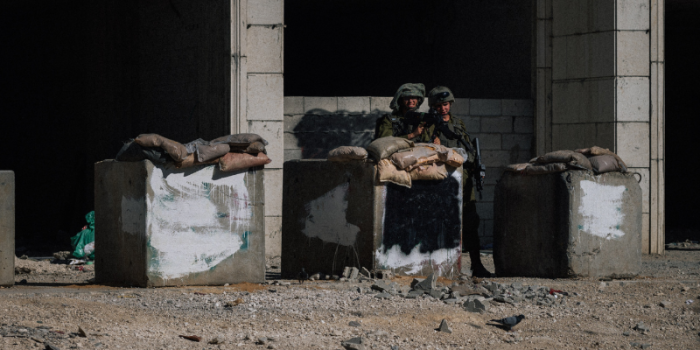
Photo: Dan Vernon
On 15 May 2026, in response to the public invitation from the Committee on Economic, Social and Cultural Rights (CESCR) for inputs to inform its work on elaborating a draft General Comment on the Application of the International Covenant on Economic, Social and Cultural Rights in Situations of Armed Conflicts, Al-Haq submitted its initial views to the Committee.
Al-Haq welcomes the decision of the Committee to elaborate a General Comment on the application of the International Covenant on Economic, Social and Cultural Rights (ICESCR) in situations of armed conflicts, and looks forward to engaging with the Committee’s ongoing consultations in developing the content of the General Comment.
As a Palestinian human rights organisation, Al-Haq has for decades stressed the importance of the enforcement of international law during armed conflict, and has, specifically, with regard to the prolonged and unlawful occupation of the occupied Palestinian territory, sought to advance accountability for violations of economic, social, and cultural (ESC) rights, including violations for which Third States and corporate actors are responsible.
The recent jurisprudence of the International Court of Justice (ICJ) concerning Israel’s military occupation of the Occupied Palestinian Territory (OPT) indicates that a comprehensive review of the applicable international legal framework is both necessary and practicable, presenting an opportunity for mainstreaming of ESC rights in situations of armed conflict, and countering the fragmentation of international law.
The 2024 Advisory Opinion on the Legal Consequences arising from the Policies and Practices of Israel in the Occupied Palestinian Territory, including East Jerusalem, in concluding on Israel’s overall illegal policies and practices, revitalised the significance of ESC rights during armed conflict, ensuring that their systematic violation are recognised both as discrete violations of international legal obligation, and evidence of structural illegality such as apartheid and unlawful occupation.
In its 2025 Advisory Opinion on the Obligations of Israel in relation to the Presence and Activities of the United Nations, Other International Organizations and Third States in and in relation to the Occupied Palestinian Territory, the ICJ reaffirmed the importance of respect for ESC rights in connection with the right to self-determination: ‘The deprivation of a people of its essential means of subsistence threatens the fundamental conditions that are indispensable for that people to exercise its right to self-determination.’
Al-Haq’s litigation during the course of Israel’s genocide has demonstrated the existence of an accountability and governance gap, whereby national courts have facilitated the discretion of governments to continue their arms trade with Israel, despite such conduct being in violation of ESC rights applicable during armed conflict. Al-Haq proposed that the Committee review the manner by which ICESCR rights and obligations, particularly pertaining to arms trade, are to be understood as applying within national jurisdictions, in order to ensure the viability of the necessary judicial remedies as required by the ICESCR.
Al-Haq also drew to the Committee’s attention the urgency of addressing the role and accountability of the UN Security Council and the manner by which it has endorsed the so-called Board of Peace, by way of UN Security Council Resolution 2803. While the ICESCR was established with the intention of promoting the progressive realisation of ESC rights, the Board of Peace represents an example of how international institutions are being abused to achieve the erasure of human rights. Al-Haq proposed that the Committee address the legal consequences of the UN Security Council’s and World Bank’s conduct in light of the UN Charter, the ICESCR, IHL, and the ICJ’s advisory opinions on the legal responsibilities of international organisations.