

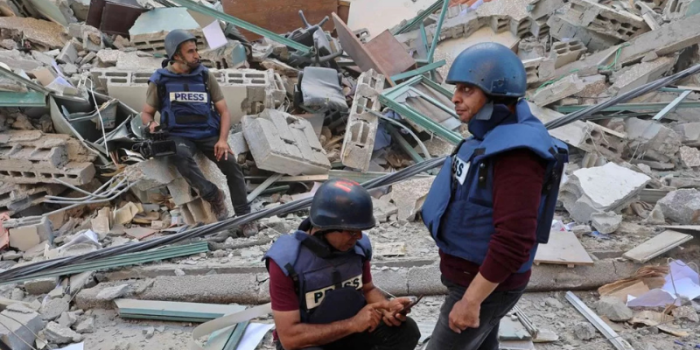
Photo: Palestinian Journalists Syndicate
On 20 April 2026, Al-Haq made a submission to the UN Special Rapporteur on the Occupied Palestinian Territory, in response to a call for input on the “role of media in the context of Israel’s policies and practices toward the Palestinian people, especially after 7 October 2023”. Al-Haq’s submission to the UN Special Rapporteur documents the widespread and systematic targeting of Palestinian journalists and media workers, highlighting patterns of conduct that amount to grave breaches of international law, mass atrocity crimes and evidence of genocidal intent.
In a context of a total blockade, including telecommunication blackouts and denial of entry to any investigative bodies or fact-finding missions, journalists play a critical role in exposing violations of international law and ensuring accountability. Yet, as Al-Haq’s submission underscores, rather than receive the protection afforded to them under international humanitarian law, they have instead been deliberately targeted by Israeli forces. Our organisation has documented numerous incidents in which clearly identifiable journalists – wearing press vests and travelling in marked vehicles – were subjected to direct attacks, including artillery shelling, sniper fire, and missile attacks.
Testimonies collected by Al-Haq reveal a consistent pattern: journalists are not merely caught in crossfire but are intentionally pursued and attacked, even while attempting to flee or after reaching areas designated as so-called “safe zones” for forcibly displaced civilians. Survivors describe being repeatedly targeted, witnessing their colleagues being killed, and suffering life-altering injuries, including amputations and loss of eyesight, as a direct result of these attacks. In several cases, journalists were targeted within minutes of arriving at locations to report, indicating premeditated surveillance and intent.
The submission further highlights how Israel’s blockade and restrictions on telecommunications have compounded the risks faced by journalists. Media workers are often forced to gather in known locations with limited internet access to transmit footage, effectively exposing themselves to targeting. These conditions, coupled with the destruction of infrastructure and denial of medical care, have rendered journalistic work in Gaza not only life-threatening but systematically suppressed.
Al-Haq concludes that these acts constitute serious violations of international humanitarian law, international human rights law and international criminal law, including genocide. As civilians, journalists are protected under the principle of distinction and must not be targeted. The documented incidents meet the legal thresholds for war crimes, including wilful killing and wilfully causing great suffering or serious injury. When assessed cumulatively, they also form part of a widespread and systematic attack against a civilian population pursuant to an Israeli State policy, amounting to the crimes against humanity of murder, apartheid, and persecution. Finally, the killing and infliction of serious bodily and mental harm to Palestinian journalists and media workers amounts to genocidal acts as they are committed in the context of Israel’s ongoing genocidal campaign in Gaza and destruction of the Palestinian people.
Due to the scale, consistency, and context of these attacks, including overtly genocidal statements made by Israeli officials, the routine targeting of journalists and media workers indicate a pattern of conduct that further attests to Israel’s genocidal intent. The deliberate targeting of those documenting violations serves to obscure evidence, silence witnesses, and facilitate the continued commission of atrocities in Israel’s ongoing genocide against the Palestinian people.
It is of paramount importance to note, as Al-Haq did in its submission, that the targeting of journalists is not only an attack on individuals but on the international community’s ability to access truth and ensure accountability. Ending impunity for crimes against journalists is essential not only for the protection of media workers and the legitimacy of international law, but for safeguarding the fundamental right to truth.