

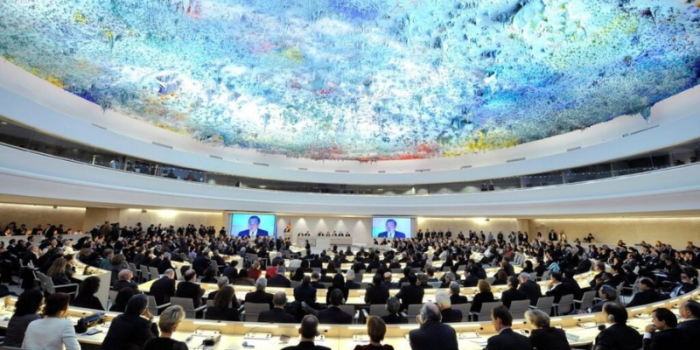
On 16 February 2026, Al-Haq as part of a coalition of organisations, sent a letter to all Permanent Representatives to the United Nations Office, urging hybrid participation during informal consultations on resolutions throughout 2026 UN Human Rights Council sessions (HRC61, HRC62 and HRC63).
During the COVID-19 pandemic and in the period that followed, the Human Rights Council (HRC) and other human rights mechanisms in Geneva set an excellent example for the UN-wide system and strengthened their work through live online interventions and pre-recorded videos, coupled with in-person participation. These remote interventions improved the accessibility, diversity and representation for civil society, and victims and survivors of violations, especially those in the Global South and from underrepresented and marginalised groups. This has been crucial in ensuring the discussions, debates, and decisions of the HRC are informed by and relevant to those whose rights are affected, bringing human rights defenders and victims of violations closer to the UN human rights system.
Since the beginning of 2024, however, we have witnessed the erosion of best practices, including the creation of further barriers to civil society participation, such as the requirement to pay to use the WebEx system and translation booths during side events, significant cuts in funding for travel, and growing difficulties obtaining visas to enter the host country.
We are particularly alarmed by the consolidation of the decision requiring States to pay for the use of WebEx for hybrid informal negotiations on draft resolutions. Since these measures have been put in place, we witnessed that only very few informal consultations have been made available via WebEx, which has greatly compromised the ability of human rights defenders and organisations, particularly those from the Global South, to engage and contribute to the negotiations.
Amid funding constraints and staffing shortages, remote participation modalities have become essential for easing heavy workloads by enabling multiple stakeholders to take part in discussions and negotiations from a distance. These modalities have also supported delegations with varying resource levels - particularly from Small Island and Developing States (SIDS) - by reducing disparities and fostering more inclusive and meaningful engagement with the Council. The requirement to travel to Geneva to participate in informals in person also has adverse environmental impacts.
We reiterate that an inclusive approach to participation requires the United Nations to address the limited space for civil society engagement. In this regard, for the past two years, we have urged States, particularly those introducing resolutions during the HRC sessions, to ensure that all informal consultations are made available on WebEx to allow for broad and diverse participation from civil society organisations, human rights defenders and SIDS delegations who cannot attend the session in person. In the meantime, we have also urged UNOG to resume the practice of making the WebEx links available for both side events and informals without charge.
Furthermore, we take this opportunity to call on States to address the ongoing liquidity crisis and its dire consequences on the work of the Human Rights Council and related mechanisms and to prevent the instrumentalisation of the cash flow crisis to create further restrictions on civil society participation and engagement with the HRC.
States have the opportunity to continue to build on the good practices adopted in the past years and allow for a broader, more inclusive, effective, and climate-friendly human rights system, including by providing access to negotiations on human rights resolution that can greatly benefit from the lived experiences of human rights defenders.
Signatories:
-
Action Canada for Sexual Health and Rights
-
Al-Haq, Law in the Service of Man
-
American Association of Jurists (AAJ)
-
American Civil Liberties Union
-
Amnesty International
-
Article 19
-
Asia Pacific Alliance for Sexual and Reproductive Health and Rights (APA)
-
Asian Forum for Human Rights and Development (FORUM-ASIA)
-
Association for Progressive Communications (APC)
-
Association for the Prevention of Torture (APT)
-
Association for Women’s Rights in Development (AWID)
-
BAGSO - Bundesarbeitsgemeinschaft der Seniorenorganisationen
-
Cairo Institute for Human Rights Studies (CIHRS)
-
Center for Health, Human Rights and Development (CEHURD)
-
Center for Reproductive Rights
-
Centro de Estudios Legales y Sociales (CELS)
-
Child Rights Connect
-
CHOICE for Youth and Sexuality
-
CIVICUS
-
Commonwealth Human Rights Initiative
-
Conselho Indigenista Missionário - CIMI
-
Earthjustice
-
Egyptian Initiative for Personal Rights (EIPR)
-
European Network on Statelessness
-
Federatie van Nederlandse Verenigingen tot Integratie van Homoseksualiteit - COC Nederland
-
FIAN International
-
Fondation du Docip
-
Franciscans International
-
Global Initiative for Economic, Social and Cultural Rights (GI-ESCR)
-
Group of Partners for Youth Affairs
-
HelpAge International
-
Human Rights House Foundation (HRHF)
-
Human Rights Watch
-
Humanists International
-
ILGA World (International Lesbian and Gay Association)
-
Initiative de Promotion de l'éducation des Batwa pour le Développement Durable, IPREBAD
-
Instituto Brasileiro de Direitos Humanos - IBDH
-
International Bar Association’s Human Rights Institute (IBAHRI)
-
International Commission of Jurists (ICJ)
-
International Federation for Human Rights (FIDH)
-
International Federation of ACATs
-
International Longevity Centre Canada
-
International Longevity Centre Global Alliance
-
International Movement of Catholic Students (IMCS/MIEC) Pax Romana
-
International Network for the Prevention of Elder Abuse (INPEA)
-
International Planned Parenthood Federation
-
International Rehabilitation Council for Torture victims (IRCT)
-
International Service for Human Rights (ISHR)
-
Justiça Global
-
Make Mothers Matter (MMM)
-
Mouvement contre le racisme et pour l'amitié entre les peuples (MRAP)
-
Network for Adolescent and Youth of Africa (NAYA)
-
Noor
-
Omega Research Foundation
-
Peace Brigades International
-
Plan International
-
Privacy International
-
RFSL- The Swedish Federation for LGBTIQ people's Rights
-
Save the Children
-
Sexual Rights Initiative (SRI)
-
Stolen Dreams
-
United Against Torture Consortium
-
Walk Free
-
Washington Brazil Office
-
West African Human Rights Defenders’ Network
-
Women Deliver
-
Women’s International League for Peace and Freedom (WILPF)
-
World Organisation Against Torture (OMCT)
-
World Uyghur Congress