

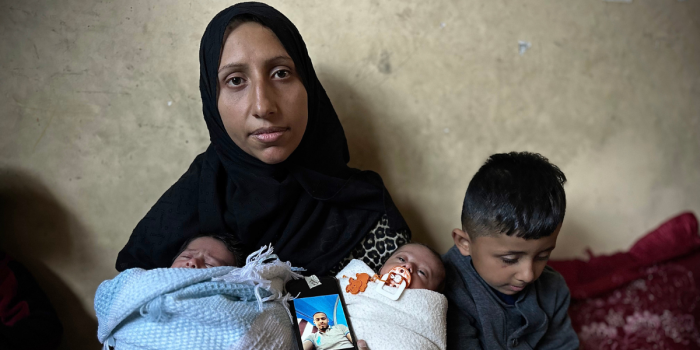
Photo: Doaa Albaz
On 10 December Al-Haq submitted comments to the UN Committee on the Elimination of Discrimination Against Women (CEDAW) on the Draft Addendum to General Recommendation No. 30 on Women in Conflict Prevention, Conflict and Post Conflict Situations. The clear gendered impact of Israel’s mounting attacks against the Palestinian people, including its AI-driven genocidal campaign in Gaza and state policy of torture through sexual and gender-based violence, formed the basis of Al-Haq’s Comments on the Draft Addendum to General Recommendation No. 30 (2013) (the Addendum).
Al-Haq’s comments on the Addendum urge the Committee on the Elimination of Discrimination against Women (CEDAW, the Committee) to further emphasise and integrate a gender-competent, intersectional analysis to properly recognise and address the deepening and expanding patterns of sexual and gender-based violence (SGBV) and conflict-related sexual violence (CRSV) perpetrated against Palestinian women and girls, and to confront the accelerating militarisation of AI that is driving its destruction of the Palestinian people.
Testimony documented by Al-Haq, supported by the findings of the UN Independent International Commission of Inquiry on the Occupied Palestinian Territory, including East Jerusalem, and Israel, reveal Israel’s systematic attacks against the dignity, privacy, and cultural and religious identity of Palestinian women. Forced nudity, forced removal of the veil, invasive and repeated strip searches, verbal harassment, and photographing and filming the commission of these criminal acts against women and girls constitute deliberate assaults rooted in a context where bodily integrity, modesty, and spiritual practice carry profound cultural significance. Survivors describe experiences that have left enduring psychological trauma, reporting that these violations surpassed even physical torture in the degree of harm inflicted. Women stripped multiple times, forced to remove their veil, photographed against their will, and humiliated in front of others recount memories that “still haunt” them, echoing the Commission’s recognition that such acts inflict deep and irreparable communal and individual harm in a society with religious and cultural dress codes.
A gender-competent and intersectional analysis—one that recognises culture, religion, age, indigeneity, and social structure—is essential to understanding these abuses. International standards, including the ICC Office of the Prosecutor’s Policy on Gender-Based Crimes and the Hague Principles on Sexual Violence, stress that the sexual nature and gravity of an act cannot be divorced from the social and cultural context in which the violence occurs. In Palestine, parts of the body deemed intimate, and thus violations thereof, take on distinct meaning. Israel’s systematic targeting of these intimate and identity-defining elements cannot be dismissed as incidental or “non-sexual”; they are core components of CRSV that Al-Haq stressed must duly recognised in the Addendum.
Palestinian women are subjected to gendered harms beyond direct physical assault. In the occupied West Bank, including East Jerusalem the demolition of homes and agricultural buildings and targeting of critical civilian infrastructure such as water systems by both Israeli forces and illegal settlers disproportionately impacts women, who bear primary responsibility for livestock, water management, and family care. The lack of privacy and access to water have forced Palestinian women and girl to resort to using scraps of sponge from destroyed mattresses as makeshift sanitary pads when demolitions left them without private spaces, facilities, or hygiene supplies. These conditions constitute a direct and intentional assault on the dignity and health of women and girls.
Compounding these violations is the unprecedented role of AI-enabled decision-support systems in Israel’s military operations. In the Addendum, the transformative role of AI in conflict and warfare is inaccurately presented as a potential concern in the future. AI has already transformed the scale and speed of Israel’s targeting processes. Platforms such as ‘The Gospel’, which can produce a hundred targets per day – ranging from family homes to entire high-rise buildings – and tools like ‘Where’s Daddy?’, used to trigger lethal strikes on family homes, have enabled the decimation of Gaza’s civilian infrastructure. UN mechanisms and independent investigations now widely recognise AI as a key contributing factor to the staggering civilian death toll. Women and children are overwhelmingly killed in homes, and have borne the brunt of these attacks with Israel having damaged or destroyed 92 percent of Gaza’s residential buildings with the knowledge of the clear gendered and generational impact.
Finally, as highlighted to the Committee by Al-Haq, Israel’s AI-driven genocidal warfare is carried out with the assistance of major technology corporations. Google, Amazon, Microsoft, OpenAI, and Palantir are central to providing the necessary cloud infrastructure, machine-learning capabilities, surveillance tools, and battlefield analytics to the Israeli military. This raises grave concerns under international law due to the lack of any binding governance framework or intent to pursue corporate accountability. Despite providing the digital machinery relied on by Israel to carry out its genocide against the Palestinian people and maintain its unlawful occupation, these companies have expanded their contracts with Israeli authorities and even changed their corporate policies to enable the continued deployment of AI-enabled systems that facilitate and drive Israel’s relentless attacks, mass surveillance, and gross violations of human rights. Their actions run contrary to the UN Guiding Principles on Business and Human Rights, which require heightened human rights due diligence and mandate that companies avoid contributing to atrocities. These obligations are being systematically ignored, as they continue to profit from the destruction of the Palestinian people and their homeland with total impunity. Therefore, Al-Haq called on the Committee to reflect in the Addendum the need for immediate international action to ensure corporate accountability for SGBV and address the legal vacuum that currently exists.