

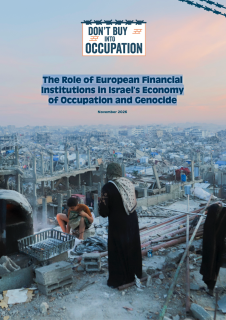
- The sixth Don’t Buy into Occupation report exposes extensive financial ties between European institutions and companies linked to Israel’s occupation and the genocide in Gaza.
- Over the past two years, European financial institutions provided USD 361 billion in loans and underwriting to these companies. They also held USD 1,745 billion in investments in these companies.
- BNP Paribas, HSBC and Deutsche Bank remain among their largest creditors, each providing more than USD 40 billion in loans and underwriting in recent years.
- Despite years of scrutiny over Caterpillar’s involvement in human rights violations, Barclays and Société Générale increased their credits from USD 1.5 billion to USD 2.1 billion, while BNP Paribas and HSBC increased theirs from USD 721 million to USD 984 million.
November 25th, GENEVA — European financial institutions provided USD 2,106 billion in loans, underwriting and investments to companies linked to grave violations of international law and human rights in the Occupied Palestinian Territory (OPT), according to the sixth Don’t Buy into Occupation (DBIO) report, launched today in Geneva.
The report is published by a coalition of 30 Palestinian and European civil society organisations. It identifies financial relationships between 1,096 European financial institutions - including banks, asset managers, insurers and pension funds - and 91 companies linked to human rights violations in the OPT.
The findings come weeks after the UN Independent International Commission of Inquiry concluded that Israeli authorities and forces continued to commit genocidal acts in Gaza, including after the ceasefire, with the intent to destroy Palestinians in whole or in part.
“It is shocking that, despite widespread international condemnation and repeated calls for action by the International Court of Justice and the United Nations, so little has changed. This is the sixth edition of this report and the fourth since the genocide began. Financial institutions know about the atrocity crimes taking place in Gaza, the companies involved and their own financial links to these businesses. We have raised these concerns with them repeatedly. This is not a lack of information; it is a failure to act.”
Among the financial institutions researched, BNP Paribas, HSBC, Deutsche Bank and Barclays have consistently ranked among the five largest creditors identified by DBIO over the past three years. Deutsche Bank tops this year’s ranking, with USD 57.2 billion in loans and underwriting to the companies under scrutiny.
The case of Caterpillar illustrates the persistence of these financial ties despite years of scrutiny. According to Who Profits, Caterpillar has long supplied the Israeli military with armoured bulldozers and excavators. Its machinery has been used to demolish Palestinian homes and infrastructure, support military operations, and build settlements and the Separation Wall.
Yet banks such as Barclays, Société Générale, BNP Paribas and HSBC have not only continued to finance Caterpillar; they have also considerably increased their financing in recent years.
The 91 companies identified in the report operate across sectors linked to violations against Palestinians, as documented in the AFSC and Who Profits databases.
They include arms manufacturers such as Lockheed Martin, Leonardo and BAE Systems, which supply weapons, missiles and ammunition to the Israeli army, as well as Boeing and Thyssenkrupp, which produce military aircraft and naval vessels.
The military supply chain extends far beyond weapons. Technology companies provide digital systems used to gather and analyse intelligence, conduct surveillance and identify targets. Among the top 20 companies receiving the highest credit volumes are Amazon, Google/Alphabet and Microsoft, whose technologies include cloud computing, artificial intelligence and data-processing systems. This enables the Israeli army to set up mass surveillance programs of Palestinians and identify targets for bombings.
Financial institutions have a responsibility to ensure their activities do not contribute to international law and human rights violations. This is recognised under the UN Guiding Principles on Business and Human Rights (UNGPs) and the OECD Guidelines for Multinational Enterprises on Responsible Business Conduct, which provide a framework for addressing adverse impacts that companies and financial institutions are involved in. Failure to meet their responsibilities exposes financial institutions and their staff to legal liability including potentially criminal prosecution for war crimes and other atrocity crimes.
DBIO therefore calls on European financial institutions to strengthen their human rights due diligence, adopt clear lending policies for companies operating in conflict-affected and high-risk contexts, and use their financial leverage to drive measurable changes in corporate behaviour. Where companies fail to address their involvement in grave violations of international law, financial institutions should end their financial relationships.
Recent decisions by major financial institutions demonstrate that financial ties can be reconsidered and, where necessary, severed. In May 2026, HSBC sold all its remaining shares in Elbit Systems, a major supplier of weapons to the Israeli military. In April, ABP, the Netherlands’ largest pension fund, withdrew its investment in US technology company Palantir, whose technology has been associated with mass surveillance of Palestinians.
“Financial institutions have the tools to influence corporate behaviour through the conditions they set, the credit they provide and the relationships they choose to maintain. After years of unimaginable violence against Palestinians, words and dialogue are no longer enough. Financial institutions should set clear, time-bound expectations for companies to end their involvement in human rights abuses. Where dialogue fails to bring about meaningful change, they must be prepared to withdraw financing and divest. The question is no longer whether financial institutions can act, but whether they are willing to use that power to help end serious human rights abuses.”
The “Don’t Buy into Occupation” (DBIO) coalition is a joint initiative bringing together 30 Palestinian, regional and European organisations based in Belgium, France, Ireland, the Netherlands, Norway, Spain and the United Kingdom (UK). Its members include human rights organisations such as FIDH, corporate accountability NGOs such as BankTrack and FairFin, and trade unions such as CGT and ACV. The coalition aims to investigate and highlight the financial relationships between business enterprises involved in the Occupied Palestinian Territory (OPT) and European Financial Institutions (FIs).
For media enquiries or comment, please contact
Willem Staes: +32 476 34 81 77 or [email protected]