

On 29 December, South Africa instituted proceedings against Israel at the International Court of Justice (‘ICJ’ or ‘the Court’), in accordance with Articles 36 (1) and 40 of the Statute of the Court and Article 38 of the Rules of Court, on the basis of alleged breaches of the 1948 Convention on the Prevention and Punishment of the Crime of Genocide (‘Genocide Convention’ or ‘Convention’).1 The application contained a request for the indication of provisional measures, pursuant to Article 41 of the Statute of the Court, to protect the rights invoked from imminent and irreparable loss. Since South Africa’s application, the Court has issued three Provisional Measures Orders (‘PMOs’).
In the time since the Court issued its most recent Order in indicating provisional measures on 24 May 2024, close to a dozen reports have been released by United Nations (‘UN’) bodies and experts on Israel’s commission of international crimes in the Gaza Strip, including by the and the UN Special Rapporteur on the situation of human rights in the Palestinian Territory occupied since 1967, and a Legal analysis of the conduct of Israel in Gaza pursuant to the Convention on the Prevention and Punishment of the Crime of Genocide by the UN Independent International Commission of Inquiry on the Occupied Palestinian Territory, including East Jerusalem, and Israel.2 In July 2024 the ICJ issued its authoritative Advisory Opinion on the Legal Consequences Arising from the Policies and Practices of Israel in the Occupied Palestinian Territory, including East Jerusalem, in which it confirmed the illegality of Israel’s presence in the Occupied Palestinian Territory (‘OPT’) and affirmed that Israel must immediately cease all new settlement activities, evacuate all settlers and fully withdraw from the entirety of the OPT as rapidly as possible. Another Advisory Opinion, on the Obligations of Israel in relation to the Presence and Activities of the United Nations, Other International Organizations and Third States in and in relation to the Occupied Palestinian Territory, responding to Israel’s continued targeting of UN personnel, premises, and aid workers, was requested in December 2024. Notwithstanding the mounting attacks against the International Criminal Court (‘ICC’), and the foreseeable, detrimental consequences to the institution when pursuing accountability for Israel, the ICC found it necessary to issue arrest warrants charging Israel’s Prime Minister and former Minister of Defence with war crimes and crimes against humanity.
Despite these landmark legal developments, Israel's genocide continues unabated. The international community, and individual States, have not only failed to hold Israel accountable and enforce international law – including the binding provisional measures indicated by the Court – they have protected Israel’s impunity, and continued to provide it with diplomatic cover as well as the financial and material means necessary to carry out its genocide against Palestinians in Gaza, where the situation has deteriorated beyond belief. By September 2025, the United States had sanctioned the Prosecutor of the International Criminal Court (ICC), six Judges of the ICC,3 two Deputy Prosecutors of the ICC, the United Nations Special Rapporteur on the Occupied Palestinian Territory,4 and three of the leading Palestinian human rights organisations, Al-Haq, Al Mezan Center for Human Rights and the Palestinian Centre for Human Rights.5
Widespread famine, malnutrition, and disease are continue to claim Palestinian lives, with the World Food Programme (‘WFP’) Director of Emergencies warning that conditions in Gaza are “unlike anything we have seen in this century”.6 Escalating ground incursions and clear preparatory steps to permanently occupy the Gaza Strip, along with a vast body of evidence of non-compliance with the rulings of the Court, necessitates revisiting, and finally enforcing, the provisional measures ordered by the Court in South Africa v. Israel.
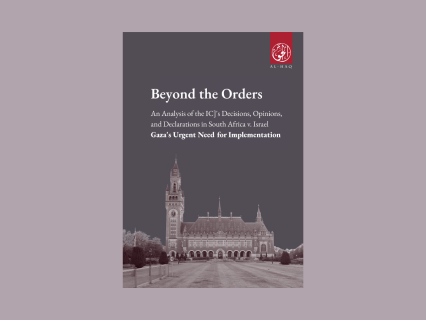
This report, completed in mid-September 2025, provides an in-depth analysis of the Court’s three separate Orders on provisional measures – along with each individual or minority opinion issued by the Judges in the context of the South Africa v. Israel proceedings. Article 57 of the Statute of the Court accords to judges the right to attach individual opinions to judgments and other decisions of the Court, such as Orders on provisional measures or Advisory Opinions, if the decision does not fully represent their own view. Individual opinions may include concurring, dissenting, and separate opinions, as well as declarations. The concept of allowing members of a collegiate judicial body to give their individual, and often diverging, opinions on the legal questions presented stems from the Anglo-Saxon or common law judicial system, and is a feature of most international judicial bodies, including the International Tribunal of the Law of the Sea, the European Court of Human Rights, the Inter-American Court of Human Rights, and the African Court of Human and Peoples’ Rights.7 While individual opinions, sometimes termed ‘minority opinions’, rarely obtain explicit endorsements in subsequent cases, these opinions can still contribute to the development of international law by influencing future interpretations and the Court’s own understanding of complex legal issues. Furthermore, they provide insight into the reasoning behind the judges votes and consequently enhance the transparency of the proceedings and facilitate intellectual dialogue within the Court itself. Additionally, where the judicial bench is divided on a key legal issue – such as whether there is a plausible risk of genocide or whether there is a change in circumstances that would warrant the indication of further provisional measures – individual opinions containing clear, well-substantiated reasoning may proactively reconcile or bridge gaps between existing divided opinions, which can be availed of in subsequent practice.8
Beyond examining each judicial decision, as well as the differences and similarities between them, to ascertain the content and scope of Israel’s ongoing obligations pursuant to the Orders, the report explores the impact of the Orders on obligations of Third States and corporations. This includes State obligations under the Genocide Convention, individual criminal responsibility for the crime of genocide under the Rome Statute, and corporate complicity in genocide. Finally, and prior to concluding, focus will shift to the relevance of the Orders to the situation in Gaza, thereby highlighting the urgency of their immediate enforcement.