

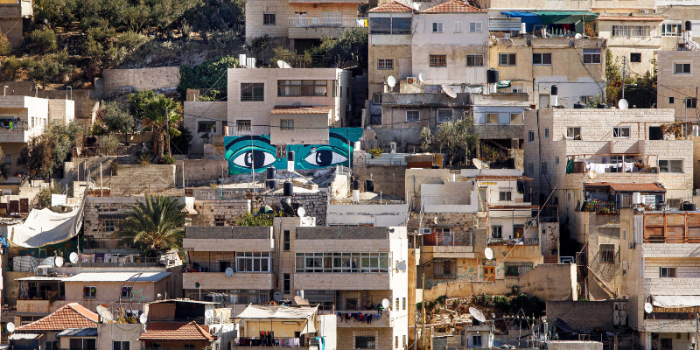
Photo: Kobi Wolf for Art Forces
"Our ordeal began in earnest between March 20 and 22, 2026, when occupation forces stormed the Batn al-Hawa neighbourhood and deployed a heavy military presence, in preparation for enforcing eviction orders issued by Israeli courts. During those days, which coincided with Eid al-Fitr, two apartments belonging to our family were forcibly evicted; we were forced to leave, and the apartments were sealed with iron locks under the protection of the occupation forces, who assaulted residents who tried to object and used tear gas and pepper spray, causing cases of suffocation. We remained in two other apartments. Then, at dawn on March 25, 2026, large numbers of occupation forces, accompanied by settlers, stormed the neighbourhood, completely sealed off its entrances, and then violently raided the building."
Since January 2026, Al-Haq has documented the demolition by the Israeli Occupying Forces (IOF) of 29 Palestinian homes in Silwan, part of a wider pattern that has seen Israel destroy 264 Palestinian homes in the neighbourhood since 2019. These demolitions form part of a broader pattern of displacement and dispossession targeting Palestinian residents of Occupied Palestinian Territory (OPT), including specifically East Jerusalem.
On 25 March 2026, sixteen families living in fifteen residential apartments in Batn al-Hawa were forcibly evicted and displaced from their homes in Silwan, Jerusalem. The evictions resulted in the displacement of 75 Palestinians from their homes, including 34 children, 16 women, and elderly people. The evictions were carried out by Israeli Occupation Forces (IOF) with the participation of settlers affiliated with the “Ateret Cohanim” settler organisation. Furniture and belongings were destroyed or confiscated, families were denied sufficient time to gather their possessions, and settlers moved into the vacated homes within hours, raising Israeli flags and installing surveillance cameras.
These evictions were enabled by Israel's discriminatory application of the 1970 Legal and Administrative Matters Law, which permits Jewish individuals or historic trusts to reclaim land in East Jerusalem allegedly owned before 1948, a legal right strictly denied to Palestinians whose property was appropriated in West Jerusalem during the same historical period. For families such as the Al-Rajabi and Basbous households, the 2026 evictions mark yet another forced displacement in a cycle stretching back to 1948, and their replacement with illegally transferred Israeli settlers.
The forced eviction and displacement of Palestinian families in Silwan, carried out through discriminatory property laws, coercive administrative practices, and the denial of repair permits, amounts to:
- Unlawful Deportation or Transfer as a war crime under Article 8(2)(a)(vii) of the Rome Statute, and a violation of Article 49 of the Fourth Geneva Convention, which prohibits forcible transfer of protected persons regardless of motive, including through the creation of coercive environments
- Extensive Destruction and Appropriation of Property as a war crime under Article 8(2)(a)(iv) of the Rome Statute, and a violation of Article 53 of the Fourth Geneva Convention, which prohibits property destruction not required by military necessity
- Forcible Transfer as a Crime Against Humanity under Article 7(1)(d) of the Rome Statute, given the systematic and widespread nature of displacement across Silwan
- Apartheid under Article 7(1)(j) of the Rome Statute, evidencing intent to maintain Israel's institutionalised regime of systematic oppression and domination over the Palestinian people
- Genocide under Article 6(b) of the Rome Statute and Article III(b) of the 1948 Genocide Convention, on account of the serious and lasting mental harm inflicted with intent to destroy the Palestinian people
These practices also breach the non-discrimination principle under Article 2 of the UDHR and ICESCR and Article 26 of the ICCPR, and violate the Palestinian people's right to adequate housing, including security of tenure, habitability, and protection from forced eviction.