

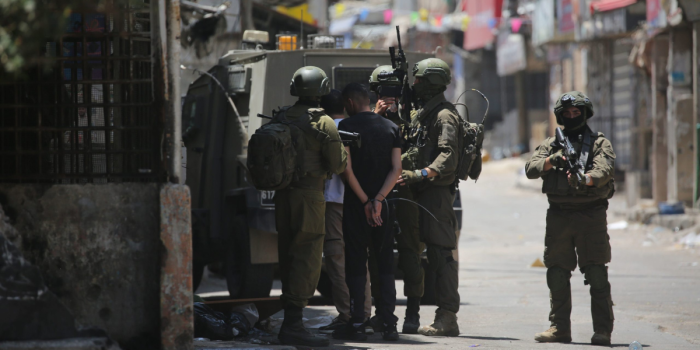
As part of its genocidal colonial violence, since 21 January 2025, the Israeli Occupying Forces (IOF) has intensified its large-scale military attack against the northern West Bank governorates. The IOF have subjected Palestinians in Jenin, Tulkarem, Tubas and Nablus to killings, arrests, mass forcible displacements, systematic destruction of civilian infrastructure, and direct acts of violence against the civilian population –– reflecting a deliberate and calculated escalation rooted in the ongoing Nakba against the Palestinian people. Such widespread and systematic attacks are intended to entrench Israel’s settler-colonial apartheid regime and unlawful occupation; and advance its annexation of the Palestinian territory.
One of the most egregious patterns of violations is the IOF’s deliberate targeting of Palestinian children and youth, which is a consistent element of its repressive policies and practices denying children their most fundamental rights: safety, freedom of movement, education, and play. This violence is not limited to physical harm; it extends to terrorisation, dehumanisation, and degrading and ill-treatment. Since 7 October 2023, the IOF have killed 1,030 Palestinians in the West Bank, including, 92 in Jenin Camp, 90 in Jenin, 77 in Nur Shams, 73 in Tulkarm Camp and 29 in Nablus. In this field focus, Al-Haq highlights the case of Ahmad Awartani, a 15-year-old child from the Al-Bustan neighbourhood in Jenin, who was directly assaulted by the IOF on 14 April 2025, while present in the Jenin Government Hospital.
I was sitting near a staircase leading to the hospital wards when a soldier suddenly approached me and others, pointing his weapon at us and shouting in Arabic, “Come, come!”. The distance between us did not exceed 4-5 meters. As the soldier approached, three others followed, and he pointed his weapon directly at my chest and ordered me, at gunpoint, to raise my hands and walk in front of him. He called me in Arabic “Mukharrebin” [literally translates to saboteurs, and meaning terrorists according to the [IOF] and used other similar language. I felt extreme fear. We walked to the entrance of the emergency department, where the soldiers forced me to stand facing the wall, as they conducted a body search, during which one of the soldiers ran his hands all over my body. The soldiers confiscated my mobile phone and forced me, under threat, to unlock it. One of the soldiers examined the phone and found pictures of Palestinian martyrs. The soldier began yelling at me, calling me “Mukharrebin”. I was then taken to the northern side of the emergency department entrance, where a soldier tied my hands behind my back with plastic ties and forced me to kneel face down on the floor. I remained in this position for approximately 30 minutes, during which the soldiers were dispersed inside the hospital.
The soldiers then took me to the hospital’s main entrance, where one of them interrogated me about the identity of the individuals found in the photos on my phone. I was then forcibly led by a soldier toward the earthen barriers, another beat me severely, particularly on my back, while another forced me to keep my head down. We walked for approximately 50-60 meters toward the camp, when the soldiers forced me again to stand with my feet apart and searched my body. The soldiers found 70 shekels and a mobile phone charger, which were also confiscated along with my mobile phone. A burlap sack was placed over my head and I was forced to kneel on the ground, unable to see my surroundings but able to feel the movements of the soldiers around me. It appears that the soldiers continued examining my phone, as one soldier pointed his weapon directly at my head and showed me a photo of a Palestinian martyr, who was killed by Israeli occupation forces, and asked me to identify him.
With the gun pointed at my forehead, I told the soldier, “I don't want to die,” fearing that he would shoot me. The soldier put his weapon away. For around half an hour, two Israeli soldiers interrogated me and beat me severely with their hands and the butts of their weapons all over my body, particularly targeting my face and back. The soldiers then tied my legs with plastic ties, shackling both my hands and feet. I was threatened with sniper fire if I moved. I sat in the middle of the street, feeling severe pain in my hands and feet from the plastic ties.
Around 3:00 pm, the soldiers finally untied me and ordered me to walk back toward the dirt mounds and return to the Jenin Governmental Hospital. One soldier told me that they will not return my phone. As I walked away, the soldiers threw stones at me, some of which hit my legs. However, I managed to climb over the barriers and return to the hospital, where I received first aid before returning home.
The IOF never returned Ahmad’s money, mobile phone, or charger. His hands were in terrible pain from the way he was bound.
The escalation of colonial violence exercised by the IOF in 2025 throughout the West Bank, including Jerusalem, has been characterised by daily IOF military incursions and raids of Palestinians towns, cities and refugee camps; the imposition of road blocks and other movement restrictions; the ongoing so-called “Iron Wall” military attack on northern West Bank governorates, which includes the mass forcible displacement of around 40,000 Palestinians from Jenin, Tulkarem, and Nur Shams refugee camps; increased state-backed settler attacks under IOF protection; home demolitions; and the unlawful seizure of large swaths of Palestinian land.
At the root of Israel’s colonial violence is the dehumanisation and discrimination against the Palestinian people that oppresses and dominates the Palestinian people. Israel’s plan to formally annex the West Bank has manifested in the increased deployment of IOF troops throughout the occupied Palestinian territory. This has resulted in increased systematic and widespread persecution of Palestinians through the intentional and severe deprivation of their fundamental rights by reason of their identity as Palestinians. Such includes heightened IOF restrictions on the freedom of movement and basic civil rights. Israel’s widespread and systematic policy of harassment, terrorisation, and dehumanisation of Palestinians is witnessed in the smallest details of their lives. Palestinians are arbitrarily searched, interrogated and assaulted in the streets, shops, and homes, and in Ahmad’s case –– in hospital.
The treatment of Ahmad Awartani constitutes serious violations of Israel’s obligations as an Occupying Power, bound by the Hague Regulations of 1907, the Fourth Geneva Convention of 1949, customary international law, and international human rights instruments. While the Occupying Power has the duty to restore and ensure public order and safety under Article 43 of the Hague Regulations, Ahmad was forcibly held for two hours and subjected to an unlawful field interrogation, which was unnecessary, discriminatory, arbitrary and disproportionate, and which violated the dignity of the child as guaranteed under Articles 27 and 78 of the Fourth Geneva Convention.
As a child, Ahmad is entitled to heightened protection under international law, including entitlement to special respect and protection under international humanitarian law (IHL), and special safeguards and care for children under Article 24 of the International Covenant on Civil and Political Rights (ICCPR). The use of force against minors must strictly comply with the principles of necessity, proportionality, and legality, with any exceptions narrowly construed and rigorously justified. In Ahmad’s case, none of these conditions were met.
Ahmad was accused of possessing images deemed sympathetic to Palestinian resistance, which posed no immediate or actual threat. During his temporary apprehension, the IOF subjected him to beatings, humiliation, and physical abuse, violating the absolute prohibitions against torture and cruel, inhuman, or degrading treatment under Article 7 of the ICCPR and the Convention Against Torture. This violence endangered Ahmad’s physical and mental well-being and constitutes a direct attack on his dignity and humanity.
Moreover, the IOF unlawfully confiscated Ahmad’s private property without any legal process. This arbitrary seizure breaches protections against unlawful interference with property rights under Article 17 of the Universal Declaration of Human Rights (UDHR). Under IHL, pillage is explicitly prohibited, and private property must be respected. Additionally, the IOF attacked the Jenin Governmental Hospital, which enjoys special protection under IHL.
Such practices reflect systematic violations embedded within the structure of Israel’s apartheid regime, representing a broader policy of racial domination and discrimination. According to Article II(a)(ii) of the Apartheid Convention inflicting serious bodily or mental harm with the purpose of establishing and maintaining domination against Palestinians as a racial group constitutes an act of apartheid, and amounts to the crime against humanity of apartheid under Article 7(1)(j) of the ICC Rome Statute. In July 2024, the International Court of Justice found in its advisory opinion that the Israeli presence in the occupied Palestinian territory is unlawful - which it must end as rapidly as possible, cease immediately all new settlement activities, evacuate all settlers, and make reparations for the damage caused to Palestinians and allow them to return to their land - and that Israel is in breach of Article 3 of the Convention on the Elimination of All Forms of Racial Discrimination (CERD), which prohibits racial segregation and apartheid.
Additionally, the widespread and systematic nature of these violations against the Palestinian people gives rise to the crime against humanity of persecution as proscribed under Article 7(1)(h) of the Rome Statute. The persecution of Palestinians through the intentional and severe deprivation of their fundamental rights by reason of their identity as Palestinians, reveals the discriminatory intent behind Israel’s egregious treatment and grave abuse of Palestinians. Said egregious treatment and abuse includes, inter alia, mass arrests and widespread denial of due process rights; the sweeping dehumanisation, cruel, inhumane and ill-treatment of Palestinians; arbitrary seizure and destruction of private property; and decades-long restrictions on the freedom of movement and basic civil rights.
The severity and increasing recurrence of such violations calls for urgent international legal scrutiny and accountability, with the goal of dismantling apartheid structures enforced against the Palestinian people and upholding their right to self-determination, intrinsic to which is the right of return.